Last week, NZ First leader Winston Peters announced his party’s bold proposal to make KiwiSaver compulsory by supporting employers through tax cuts and raising the contribution rates to 10% of wages.
This was politically significant as it puts savings reform at the centre of our economic policy debate. Peters is correct in stating that New Zealand should become a rich asset-owning country through high domestic savings rather than desperately try to rely on foreign direct investment for growth.
Deeper and more broad-based domestic capital markets provide stability and reduce vulnerability to external shocks.
Unfortunately, compared to other advanced economies, New Zealand is woefully behind in the area of retirement income, domestic savings and use of private funds to increase our investment in assets such as hospitals and infrastructure.
As one of the many young Kiwis who left to go to Australia, I am stunned by our Trans-Tasman neighbour’s financial wealth. It greatly exceeds NZ, even after adjusting for their larger population size.
Australia’s Sovereign Wealth Fund, called The Future Fund, has NZ$350 billion in assets under management.
Meanwhile, their compulsory superannuation system is world-leading. Total accumulated funds are currently NZ$4.6 trillion. It is expected to become the second-largest savings pool in the world by 2050 and is 35 times larger than total KiwiSaver balances. Every Australian has an account. Individually their balance averages 10 times the balance in one of ours.
Astonishingly, around 20% of Kiwis don’t have a KiwiSaver account, and no savings at all.
The Australian scenario would not have been possible without solid and competent political leadership. Former Australian Prime Minister Paul Keating introduced Compulsory Superannuation in 1991 to “reduce the future reliance on the age pension, and over time, give ordinary people a better retirement”. Employer contributions started at a compulsory 3% of wages per year and gradually increased to the 12% where they sit today.
Thanks to compulsory superannuation, Australia is the only country across the OECD expected to have its government old age pension spending decrease from 2.3% of GDP today to 2% of GDP by 2060. By contrast, New Zealanders’ demand on the public purse to fund our pay-as-you-go pension system is projected to rise from 4.9% to 7.7% of GDP by 2060.
There is a common theme that emerges from such comparisons. Countries that create strong compulsory savings systems can reduce the fiscal burden of public pensions and also create pools of capital which they then have available to invest in the country’s national development.
After leaving NZ to study for a master’s degree in Singapore, I was amazed to learn about the city-state’s unorthodox social security and public asset system. Its development is deeply rooted in Singapore’s national savings schemes. The country’s Central Provident Fund requires citizens to save up to 20% of their wages – with another 17% provided by their employers. It currently has NZ$834 billion under management.
Singapore’s Sovereign Wealth Funds manage more than NZ$570 billion through Temasek Holdings and NZ$1.3 trillion through the Government Investment Corporation.
Singapore’s economy is expected to continue remaining the crown jewel of Southeast Asia. It is a capital exporting nation with a current account surplus and net zero debt.
Australia and Singapore have both taken the path of focusing on long-term capital accumulation through use of sovereign wealth funds and compulsory saving schemes. It is time New Zealand follows suit.
Many older Kiwis know about how former Prime Minister Sir Robert Muldoon made an awful mistake by abolishing the compulsory superannuation scheme set up under Norman Kirk in 1974.
Peter’s new savings proposals may mark the new beginning of a bipartisan agenda for NZ’s future public asset development.
Politicians across the spectrum support this transition. Labour’s David Parker said in his valedictorian speech, “[Australia’s] universal work-based savings [is] why those clever Aussies own their banks plus ours, our insurance companies, and much more. It’s why their infrastructure is better, their current account deficit lower, their net international liabilities lower, and their growth rate higher.”
Former National Party Commerce Minister Andrew Bayly also understood the vitality of higher domestic savings. He said, “One largely untapped source is the $109 billion of capital held by KiwiSaver providers… By comparison in Australia, I understand roughly 15% of its $3.8 trillion pension fund industry is invested in alternative assets, such as private equity and infrastructure.”
Now, NZ First has proposed a policy to ensure KiwiSaver becomes a major economic vehicle for our future economy. There are gripes about the fiscal costs of the tax cuts needed to buttress compulsion – including me – but the idea behind the policy is sound.
New Zealand stands at a crossroads. Our low domestic savings rate, combined with our ageing population, poses a long-term fiscal challenge that cannot be ignored.
The late Harvard economist Martin Feldstein’s words still ring true, “The problem with the current system is that retirees’ benefits are financed on a ‘pay-as-you-go’ basis, by taxing concurrent employees. The obvious solution is to shift to a privatised system of pre-funding those benefits through mandatory contributions to individual accounts.”
Many analysts argue that foreign capital can drive investment, but as other nations have now successfully demonstrated, mandatory savings systems supplemented by Sovereign Wealth Funds strengthen not only financial stability but also productivity and national independence.
As far as I know, there are no options to addressing long-term fiscal debt problems for a country like NZ other than by hiking taxes, printing money, defaulting, or cutting public services, or by promoting domestic savings through policies that support schemes like KiwiSaver and our Super Fund.
Which one do you prefer?
Leonard Hong is an economist based in Perth, Australia who has a Master’s degree in International Political Economy from the Nanyang Technological University, Singapore (2024) with the support of the Prime Minister’s Scholarship for Asia. He is a Leadership Network Member of the Asia NZ Foundation.
The assessment of the long-term fiscal position of the United States by Harvard’s Martin Feldstein in 1997 can be applied to most of the developed world today. The ‘pay-as-you-go’ comprehensive social security system that became popular during the early period of the Keynesian Consensus supporting retirement income and healthcare is already unsustainable. Unfortunately, because of the inevitable trend of population ageing, long-term unfunded liabilities – financial obligations from governments to citizens with insufficient funds to cover future projected costs – states will be required to spend far more on healthcare and pension (Goodhart and Pradhan, 2020). In response, various governments pursued a myriad of policy options – and failed so far – to tackle this inevitable trend, including tweaks in the system including increasing the retirement age, indexation of pension and in some cases compulsory private savings towards self-provision.
The crucial question is how to accomplish and resolve this looming problem. Some suggest imposing significant tax increases – such as capital and wealth taxes favoured by the left – or cutting expenditures to an extent that undermines the poorest members of our society without an alternative safety net – which is the libertarian argument. The former option supported by the Green Party will push capital out of the nation, undermine our economy, and at best raise barely any revenue. The latter commonly from the ACT Party does not provide any alternative solutions beyond the status quo. Sentimental push from economists towards “faster productivity growth” is not a solution either (Wilkinson, 2024). In my view, there is no alternative but to prioritise raising domestic savings in New Zealand (NZ) towards supporting economic development. New unorthodox thinking and economic approach is required to resolve the challenges facing New Zealand, beyond the left-right political divide.
In response to the relatively interesting – but flawed – analysis by economist Michael Reddell (2025), this essay seeks to counter the arguments provided on the topic of savings. These were the following main arguments and points from Reddell’s article:
Economic growth has been stagnant and some analysts – including Leonard Hong – have argued for higher domestic savings and Reddell questions their conclusions.
Compulsory savings have not led to significant productivity gains and believes other variables are more important to economic success.
Reddell argues that Australia’s spending on retirement income is still relatively high for the old age pension – which is means-tested – and national savings has not risen to the extent he anticipated and productivity is nowhere near the level of the United States.
Singapore’s national savings did not play as much of a major role in the city-states’ substantial part in their economic success, but rather more from its global competitiveness and low tax settings.
The role of foreign capital and domestic capital on economic growth is still under debate, and Professor Robert MacCulloch’s argument on the “Feldstein-Horioka puzzle” is interesting, but not entirely convincing.
Savings rates are often a response to investment opportunities rather than a cause; therefore, Reddell questions the notion that low domestic savings constrain investment in countries like New Zealand.
I broadly support the idea of mandatory savings – mainly because of its pragmatism and simplicity but also the positive spillover effects as outlined from my previous academic work examining Singapore’s economic model centred around the development of public assets (Hong, 2024). Furthermore, numerically higher domestic savings increase the capital available for investment, which translates to investment in infrastructure, businesses, and innovation, and therefore higher productivity. Other scholars provided potential and feasible alternatives based on mandatory savings across various nations such as Singapore, Chile, Sweden, and Australia (Feldstein, 1998; Kotlikoff and Burns, 2004; Ferguson, 2008; Micklethwait and Wooldridge, 2014; Chia, 2016; Douglas and MacCulloch, 2018).
These are the main reasons why I have repeatedly called for a bipartisan political approach to public asset development, in the form of both supporting our KiwiSaver and our sovereign wealth fund, the NZ Superannuation Fund (NZ SuperFund). New alternative state investment vehicles in the form of institutions such as the Accident Compensation Corporation have also provided social and economic benefit to the NZ public. In contrary to Reddell – and others – I will argue that higher domestic savings, supported by a structured compulsory savings system, is essential for New Zealand’s long-term economic prosperity.
Productivity and the Role of Domestic Savings?
The productivity puzzle in NZ has been widely examined across society. Former NZ Prime Minister John Key suggested the cause of our productivity woes was our “geography” – which is in line with Jared Diamond’s (1997) argument on what mainly distinguishes rich and poor countries. Other scholars including Nobel laureates Acemoglu and Robinson (2012) highlighted the quality of political and economic “institutions”. Huntington and Harrison (2000) provided a cultural perspective on economic development and productivity, especially on aspects of work ethic, meritocracy and openness to innovation. I broadly agree with all these theories – especially the institutional argument – but the point is that the debate on what improves productivity has always a puzzle for scholars and policymakers. I am strongly convinced that higher domestic savings – complemented by overseas investment – boosts economic growth and productivity.
Australia’s Productivity
Reddell mentions that Australia’s compulsory superannuation systems set up by Paul Keating has not led to higher net national savings as anticipated despite the policy mandating private savings for retirement on the public. To his credit, it is true that savings have not been as high, but this is attributed to the ‘substitution’ incentive for Australians to borrow more money under the assumption their wealth will accumulate through their superannuation (Connolly and Kohler, 2004). This was previously examined by many behavioural economists such as Daniel Kahneman (2011) on the ‘present and status quo biases.’ However, by in large, academic studies in Australia show that compulsory superannuation still led to increases in net savings broadly (Ruthbah and Pham, 2020).
Despite the relatively mediocre net savings, Reddell points out that Australia is much wealthier than NZ with a much higher GDP per capita of around USD$20,000 stating, “Australia is, by the way, the most culturally and behaviourally similar country to New Zealand in the world.” (Isn’t the fact that the author of this essay is working in Australia somewhat ironic?). His comparison between Australia and the United States may not fully account for the unique factors that influence their economies, such as the role of the US dollar as the world’s reserve currency. Furthermore, if the United States government followed Martin Feldstein’s advice of “large-scale compulsory saving”, perhaps they would not be in such a dire fiscal situation of US$37 trillion of net government debt – culminated from the unnecessary and costly wars in the Middle East.
In relation to the comparisons with NZ, there are two major variables in my view that distinguish the two countries – iron ore and the superannuation funds sector. The former, we have limited control over – although depending on the agenda of NZ Resources Minister Shane Jones – but the latter, there is greater potential for reform.
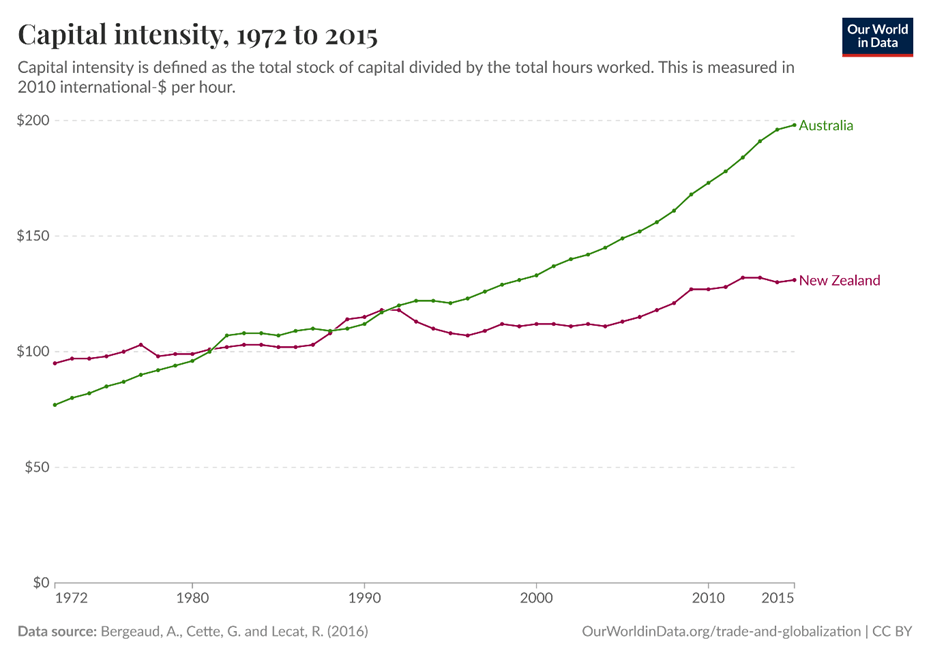
Figure 1: Capital Intensity, 1972 to 2015
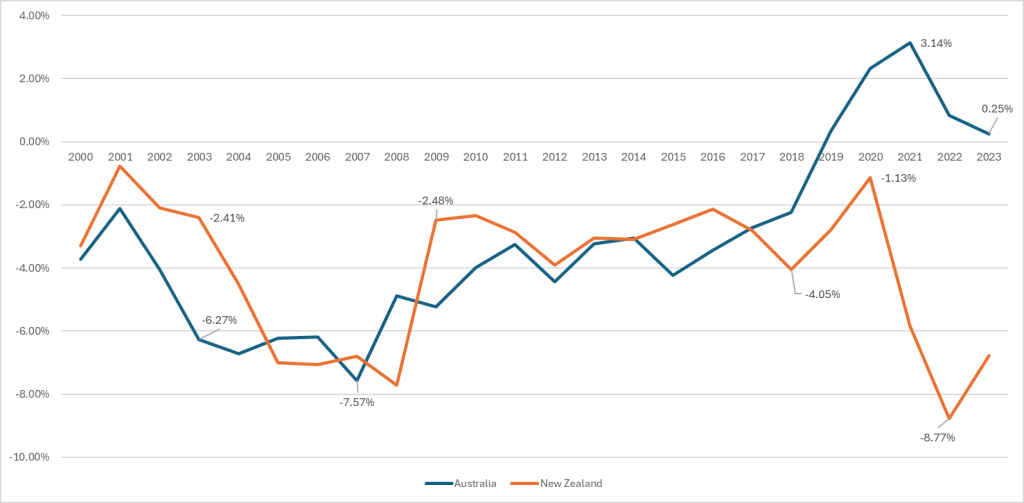
The superannuation system now manages more than AUD$4.1 trillion under management which is the fourth largest savings pool in the world which comprises of 150% of Australia’s GDP – which is expected to become the second largest savings pool by 2050. This is remarkable for the 55th largest nation in the world. This pool of capital translated to rapid increases in capital intensity for the Australian economy. As shown in Figure 1, from World in Data, the specific critical juncture was from 1991, which was when Australian Prime Minister Paul Keating decided to introduce Compulsory Superannuation to “to reduce the future reliance on the age pension, and over time, give ordinary people a better retirement.” (Keating, 2013). He had the foresight and prescience to understand that demographic pressure was inevitable. Therefore, setting up a mandatory savings scheme would allow the system to transfer more from a ‘pay-as-you-go’ system towards a ‘self-provision’ based system. To Keating’s credit, the call on the budget from the old age pension dropped from 5% of GDP in 1991 down to around 1% in 2023. Secondly, in stark contrast to NZ, Australia recently had some periods of current account surpluses starting in 2019 without needing the begging bowl to foreign investors being capital poor. However, as shown by Figure 2, there is not much difference between Australia and NZ with both countries, and I concede that this is probably the weakest point of comparison in my analysis. The differences in economic scale, trade composition, and external sector dynamics significantly influence their respective balance of payments. Although I do consider the historical hypotheticals if Keating’s original plan of raising the compulsory savings rate beyond the 9.5% to 15% was actualised, especially given that Coalition governments have frequently prioritised tax cuts over further superannuation expansion (the Morrison government did eventually raise it to 12%).
Figure 2: Australia vs NZ – Balance of Payments in Proportion to GDP, 1989 to 2023 (World Bank Data)
I am not arguing that in the short-run a current account surplus or deficit is inherently good or bad – in the long run possibly – but it is clear that Keating’s policies led to the structural transformation of Australia’s economy. Despite later Coalition governments pursuing tax cuts over further superannuation expansion, much of the accumulated savings under Keating’s framework were directed toward domestic investment, funding major infrastructure projects such as the Port of Melbourne and Transurban Toll Roads. For higher productivity focusing on capital markets, NZ can only grow by boosting both domestic savings and allowing more foreign capital into the country which will consist of cutting actual red-tape to FDI through supply-side reforms – which Reddell strongly agrees with me – and ramping up domestic savings through KiwiSaver – or other private saving investment vehicles (MacCulloch, 2024). The current National Coalition government’s emphasis has been on attracting overseas investment whilst broadly ignoring the problem of domestic savings so far.
Singapore’s Productivity
Reddell rightly praises Singapore’s economic miracle with the city-state having one of the highest per capita GDP in the world. However, he claimed that “it would be very hard indeed to argue that national savings played any very substantial part in Singapore’s economic emergence.” I believe this perspective overlooks a critical component of Singapore’s economic strategy, which was deeply rooted in their national savings system as a fundamental part of economic policy for current Singaporean politicians (Lee, 2024). Whilst the Central Provident Fund (CPF) was set up in the 1950s, it was an inherent part of the Singapore government’s fiscal strategy. Lee Kuan Yew (2000, p.97) stated he not only maintained the compulsory nature of the system but regularly raised the contribution rates to “avoid placing the burden of the present generation’s welfare costs onto the next generation.” Furthermore, according to Lee (2000, p.102-103), the critical aspect is to ensure bare minimum fiscal pressure on the state to avoid the ‘buffet syndrome’, a fact which Reddell omitted when publishing his article:
Through the CPF system, Singaporeans have access to a comprehensive self-financing social security fund comparable to any old-age pension system or entitlement system in the Western world without transferring the burden to the next generation of workers (Micklethwait and Wooldridge, 2014; Chia, 2016; Douglas and MacCulloch, 2018). The Singaporean government understood the importance that every generation should contribute to their own pension and every individual should save for their own without burdening the state. CPF has a major role on Singapore’s economy – Reddell is incorrect. The whole entire purpose was fiscal discipline which is important for long-term economic growth and macroeconomic stability (Reinhart and Rogoff, 2009).
Secondly, Reddell cites comprehensive data concerning Singapore’s current account position and national savings record in proportion of GDP from the International Monetary Fund. The question from him was the notion that the Singapore government relied on current account deficits in the early period of the 1970s and 1980s for its growth. Indeed, it is true and there is a specific reason. The East Asian Miracle – particularly in Singapore – shows that savings and investment are not separate, but interconnected variables in driving economic development.
Reddell should have considered the extensive work by development economists on the East Asian Miracle, where the initial phase of development focused on attracting foreign capital to acquire the necessary talent, business expertise, and technological spillovers that enabled these countries to build their own capabilities in the long run. This approach, championed by various economists that studied the East Asian developmental state model (Stiglitz, 1996; Chang, 2003; Rodrik, 2015; Haggard, 2018). While these nations initially relied on foreign investment, they eventually became capital-exporting economies after reaching a certain level of development and establishing competitive domestic companies and ‘national champions’. High domestic savings were critical in fostering capital formation for the Four Asian Tigers, which, in turn, led to productive investment and long-term growth.
Figure 3: Singapore Government’s NIRC and Budget Deficits/Surpluses (S$ Millions)
Furthermore, Reddell didn’t mention the importance of sovereign wealth funds for Singapore, but it is relevant to the argument in this essay – it was covered extensively across my postgraduate dissertation. Singapore relies heavily on endowment funds provided by the Government Investment Corporation (GIC) and Temasek Holdings, called Net Investment Returns Contribution (NIRC). For example, in the 2024 Budget, the Singapore government received S$23 billion through the NIRC, comprising 18% of the revenue – 3.4% of GDP. This fiscal mechanism has many benefits since it allows the state to be ‘developmental’ such as public investments in infrastructure, housing, and education, but also tax breaks for new start-ups, capital allowance on depreciable assets, 250% tax deduction on R&D expenses, low corporate tax rate of 17%. The pro-business settings – including tax breaks that Reddell gives a fair bit of credit to Singapore – was possible because of their net zero debt position with massive amount of financial assets – worth US$1.9 trillion owned by the public. As shown in Figure 3 – which is from my dissertation – seven of the ten last government budgets saw the NIRC contribute an overall surplus, despite eight budgets having a primary structural deficit.
Conclusion
In conclusion, I disagree with the premise of the article that was published by Michael Reddell. I fully support Martin Feldstein’s remarks from 1997 that the “obvious solution is to shift to a privatised system of pre-funding those benefits through mandatory contributions to individual accounts.” I do not see another alternative policy approach to tackle this looming macroeconomic problem. The mainstream economic approach currently tinkers around the edges. The status quo – even with the NZ SuperFund – will be fiscally inadequate as highlighted by the NZ Treasury’s Long Term Fiscal Position forecasts. I suggest that moving to a hybrid system like Australia with a means-tested old-age pension would be the next step by incrementally raising the minimum contribution rates to KiwiSaver – either employee or employer – as highlighted by the Retirement Commission (Katz, 2024). Andrew Coleman (2024) recently highlighted the major issue of designing the new system towards “intergenerational neutrality” without harming the younger generation to continue to pay for retirees and at the same time build a nest-egg for their future. This major issue of intergenerational fairness is a very tricky and puzzling problem for transitioning from our current ‘pay-as-you-go’ system towards a social security system based on ‘self-provision.’
Both examples of Australia and Singapore show that high domestic savings matter to a large extent on both macroeconomic stability and economic performance. I also do not see ‘domestic savings’ in a similar way to Reddell that “savings themselves are endogenous.” Savings are not entirely endogenous but can be nudged and supported through policies that incentivise individuals and households towards more private savings and investment. The fact is that NZ has one of the lowest domestic household savings across the developed world is worrisome. Therefore, reversing the trend is critical, not only for our long-term fiscal position but also our economic prospects in the future. We should be attempting to emulate parts of what Australia and Singapore have done, instead of labelling such policy proposals as ‘paternalistic’ or ‘authoritarian’.
Reddell’s statement that “retirement income policy should be approached on its own terms, with a focus on individuals and their own ability to manage retirement,” is a simple classically liberal philosophical position. The only difference from my end is suggesting that people mandatorily save rather than forcefully pay high tax rates! The state already compels the public to pay income tax, and GST, so what is the difference between taxes and being compelled to save money? A high return on private savings is achieved by investing in high-performing investments with compound interest, whereas taxes are simply a means of generating revenue for the state.
NZ is currently discussing the importance of attracting more foreign direct investment. I broadly agree that we need to make it easier for capital from overseas to invest into NZ equities, companies, land, industrial development, housing supply and our chronic infrastructure deficits highlighted by the Infrastructure Commission. However, there is a limit to this strategy as higher concentration of foreign capital also risks financial instability and tends to lead to slower growth than countries that have higher proportion of domestic savings (Prasad et al, 2007; Cavallo et al, 2016). And this idea was partially supported by Reddell who concluded in the latter part of his article stating:
Indeed, higher domestic savings by-in-large would have a positive effect on the current account, put less demand on the NZ dollar, support more exports and allow more Kiwis to accumulate foreign reserves and become a capital exporting nation.
The notion of having more savings on an individual and household level makes sense as a financial buffer and social insurance during times of personal difficulty. The prudent decision is to limit credit card debt and refrain from buying unnecessary items or making “vanity” purchases of luxury goods with credit cards. If every Kiwi behaved and understood finance like Warren Buffett and Charlie Munger, then we would not be having these policy discussions. Unfortunately, most of the NZ public do not have the appetite let alone the long term orientation or foresight to consider making sound financial decisions. If we apply this logic on a macroeconomic level, most of the readers will be able to comprehend as to why a lot of people – including myself – are advocating for mandatory savings. Former NZ Commerce Minister Andrew Bayly was pursuing important policies to kickstart financial education across our school system and I hope new Minister Scott Simpson completes the job. The average balance of NZ$38,000 for KiwiSaver is utterly woeful and nowhere enough to save for retirement – let alone purchasing a house.
I decided to respond in a comprehensive manner with this essay because Reddell is one of the most well-known economic commentators and analysts in NZ, and I have tremendous respect for his work. His compelling research with Dr Don Brash and Dr Bryce Wilkinson for the 2025 Taskforce was very useful with insightful economic suggestions. Anyone interested in economic policy should have a read – as well as his excellent blog. The debate regarding domestic savings is a necessary one, but I am confident that history will prove people such as myself to be correct in the long run.
NZ stands at a crossroads. Our low domestic savings rate, combined with an ageing population, poses a long-term fiscal challenge that cannot be ignored. Some may argue that foreign capital broadly can drive investment, but the examples of Australia and Singapore demonstrate that a comprehensive mandatory savings system not only strengthens financial stability but also boosts productivity and national resilience. In my humble opinion, there is no economic policy alternative to addressing the long-term fiscal debt problem, economic growth and productivity problems besides developing more public assets and boosting domestic savings through policies that support schemes such as KiwiSaver and the NZ SuperFund.
References
Acemoglu, Daron., & Robinson, James. (2012). Why Nations Fail: The Origins of Power, Prosperity, and Poverty. New York: Crown Publishing Group.
Cavallo, Eduardo., Eichengreen, Barry., & Panizza, Ugo. (2016). “Can Countries Rely on Foreign Saving for Investment and Economic Development?” IDB Working Paper No. IDB-WP-718. Retrieved from https://ssrn.com/abstract=2956698
Chang, Ha-Joon. (2003) Kicking Away the Ladder: Development Strategy in Historical Perspective. London: Anthem Press.
Chia, Ngee-Choon. (2016). Singapore Chronicles – Central Provident Fund. Singapore. Straits Time Press.
Feldstein, Martin. (Ed.). (1998). Privatizing Social Security. Chicago: The University of Chicago Press.
Ferguson, Niall. (2008). The Ascent of Money: A Financial History of the World. London: The Penguin Press.
Goodhart, Charles., & Pradhan, Manoj. (2020). The Great Demographic Reversal: Ageing Societies, Waning Inequality and an Inflation Revival. London: Palgrave Macmillan.
Haggard, Stephen. (2018). Developmental States: Elements in the Politics of Development. New York: Cambridge University Press.
Harrison, Lawrence., & Huntington, Samuel. (Ed.). (2000). Culture Matters: How Values Shape Human Societies. New York: Basic Books.
Hong, Leonard. (2024). “Lessons from Singapore on getting the Government’s books in shape without paying more tax.” The New Zealand Herald.
Hong, Leonard. (2024). “Savings and Sovereignty: Comparative Political Economy on Fiscal Discipline and Public Asset Management between Singapore and New Zealand.” Postgraduate Dissertation for NTU.
Kahneman, Daniel. (2011). Thinking, Fast and Slow. New York: Farrar, Straus and Giroux.
Kotlikoff, Laurence., & Burns, Scott. (2004). The Coming Generational Storm: What You Need to Know about America’s Economic Future. Cambridge: MIT Press.


 Leonard Hong