Last week, after returning to New Zealand from Singapore, Prime Minister Christopher Luxon strongly argued that “we have serious work to do on our infrastructure” compared to Singapore.
It’s public knowledge that ministers in the coalition Government admire Singapore’s economic policy approach.
The Prime Minister admires its long-term planning for development; Winston Peters wants a national infrastructure fund, emulating Temasek Holdings, and has advocated for compulsory savings, like Singapore’s Central Provident Fund (CPF) system; Deputy Prime Minister David Seymour similarly wants mandatory health accounts inspired by the CPF.
It’s not just the Government.
The Opposition under the Labour Party announced, “The Future Fund”, also partially influenced by Singapore’s sovereign wealth funds (SWFs), to “invest in infrastructure and innovative Kiwi businesses to create good, secure jobs”. The Green Party admires Singapore’s high urban density and world-leading public transport system.
The real issue is not New Zealand politicians’ admiration for Singapore, but that they cite Singapore’s successes without adopting the rigorous policies that led to the “Singapore Story”.
We have not witnessed much progress in most policy areas, and there is little congruence between words and action.
If New Zealand politicians invoke Singapore as a model, they must honestly acknowledge what underpins Singapore’s achievements – high savings, strict fiscal discipline, effective infrastructure execution, talent attraction, meritocracy, and strong state capacity. Unless we commit to these fundamentals, talk of emulating Singapore remains empty.
So, what is the secret behind Singapore’s success, and what policy lessons can it offer to boost New Zealand’s economy?
The first difference is their national savings record and fiscal discipline.
Singapore has built strong financial and fiscal institutions for accumulating national capital through compulsory savings, with its world-leading CPF system and sovereign wealth funds, GIC and Temasek Holdings.
The CPF system requires citizens to save up to 20% of their wages, with another 17% provided by their employers, and the total asset under management is around SG$661 billion ($876b). Both superannuation and healthcare are provided through mandatory individual accounts.
Temasek Holdings manages over SG$434b, while the Government Investment Corporation handles nearly SG$1 trillion. The Net Investment Returns Contribution of SG$20b funds government spending, about what Singapore spends on education annually.
Singapore has maintained an annual average budget surplus of SG$8.4b over the past three years, supported by strong economic growth and windfall tax gains. Singapore is a capital-exporting nation with zero net debt.
Conversely, New Zealand’s KiwiSaver means employees save only 3.5%, with employers contributing a further 3.5%. More than 20% of Kiwis do not have a KiwiSaver account or don’t save. Our total funds under management are only $143b, which is far below both Australia’s compulsory superannuation and Singapore’s CPF funds.
Worse, many Kiwis are withdrawing from KiwiSaver due to financial hardship. Despite the OECD’s advice, we continue to tax savings through the Employer Superannuation Contribution Tax.
Our NZ Super Fund is world-class, but its total size is $86b, which is far smaller than any SWF in Singapore.
Meanwhile, since the Covid-19 pandemic, both sides of politics contributed to the massive increase in public debt, with net core Crown debt rising to 44%.
Interest payments have increased to close to $9b. At the same time, the Government has made costly short-term commitments while borrowing remains elevated and tax revenue weakens.
New Zealand’s debt is expected to blow out to 200% by 2065, driven by population ageing and exponential increases in healthcare and superannuation, which are already crowding out discretionary spending. Even if we achieve a surplus by 2029, the long-term projection shows we are headed for a fiscal crisis.
Singapore funds long-term investment through its accumulated national wealth. In contrast, New Zealand relies heavily on foreign borrowing, has low household savings, and a weak KiwiSaver system. Our national savings rate lags far behind Singapore’s, yet there is no effort to improve domestic capital formation.
The second difference is execution. Singapore’s success is not just about prudent public finance. It is about state capacity in turning public policy into project development.
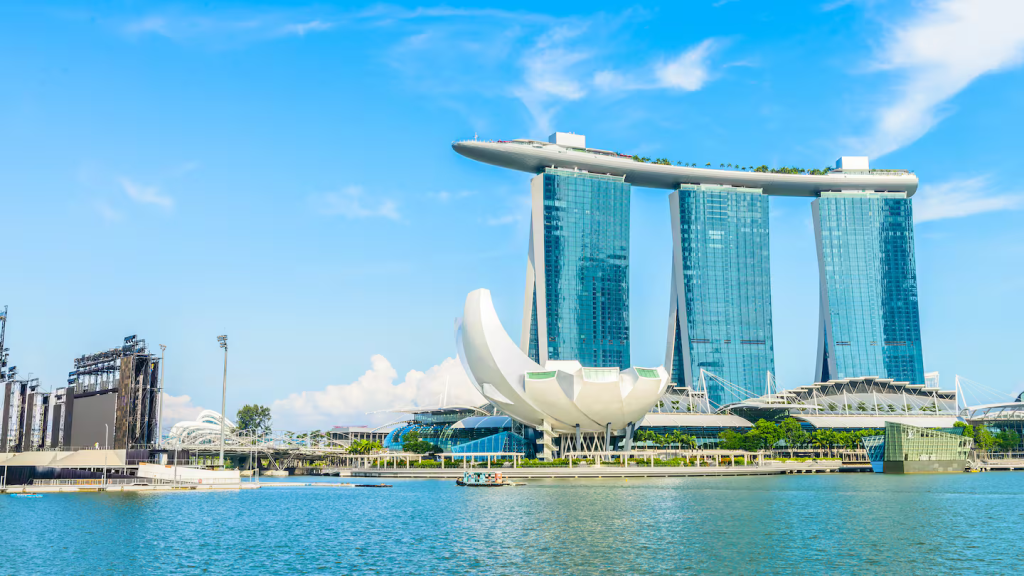
Singapore’s success is rooted in the Urban Redevelopment Authority’s centralised planning model. Its “whole-of-government” co-ordination ensures technical requirements are clear, approvals are rapid, and land-use decisions are treated as essential infrastructure. The results are Changi Airport, Marina Bay Sands and Jurong Industrial Estate.
Since the establishment of the Ministry of Regulation, few regulatory changes have meaningfully reduced compliance costs. The new Planning Act and Natural Environment Act aim to enable more development, yet do not improve the government’s regulatory execution. New Zealand’s development remains hampered by complex consenting requirements, inconsistent political decisions, and an over-reliance on public relations and consultants rather than on technical expertise.
New Zealand’s main challenge is not a lack of goals but weak implementation. Our failure to execute, in contrast to Singapore’s disciplined execution, is the real obstacle to progress.
The third difference is talent acquisition and meritocracy.
The city-state treats talent as a crucial national asset. Singapore aggressively recruits “top-tier” global talent to build new industries and companies, thanks to its low corporate tax rates and a pro-business regulatory environment.
The Government invests heavily in elite institutions, hires foreigners deemed “the best and the brightest”, and places a high value on technical excellence in government and the corporate sector. Both the National University of Singapore and Nanyang Technological University rank in the top 12 in the QS rankings supplemented by major government investments, while competing with Ivy League institutions.

Singaporean academic Kishore Mahbubani credits meritocracy for Singapore’s success. “Meritocracy is the first reason for Singapore’s success.” At its best, meritocracy means selecting people based on abilities rather than nepotism, patronage, family ties or political convenience. We see this with the credentials of various Singaporean politicians and corporate leaders who hold degrees from Ivy League institutions and Oxbridge colleges.
In contrast, New Zealand’s migration settings do not attract the best and the brightest.
Around 180 young Kiwis around my age are leaving for overseas each day. Some argue that this is identical to the past, but this time is different. Faith and trust in our country are fading fast.
Our universities lack support, and none compete globally. The Government ignored the University Advisory Group’s recommendations – led by Sir Peter Gluckman – for advancing our universities.
Furthermore, New Zealand is moving towards a culture that under-rewards excellence. Our public service and corporate boards are now frequently populated by generalist managers and consultants rather than subject-matter experts. By devaluing the “best and brightest” in favour of soft skills, we risk losing the rigorous execution capacity we had in the late nineties.
The Government has indicated and signalled its intention for an ambitious future for New Zealand. However, actions speak louder than words.
The policies under the current coalition Government have not reflected its intention to emulate Singapore’s best practices nor “fix the basics”. Neither has the Opposition presented its proper costings, economic analysis, or alternative solutions to these long-term structural challenges.
Consequently, our economic trajectory is diverging further from Singapore. Singapore’s real GDP grew at an average 3.5% per year from 2023. Meanwhile, New Zealand’s real GDP grew at a meagre 0.6% during the same period. We are experiencing one of the lowest growth rates among OECD countries.
I accept that Singapore is not a model to be copied, but it offers public policy lessons that can help us fix our productivity woes and relative economic stagnation.
Singapore’s success isn’t just a vision; it’s the result of relentless fiscal discipline and state capacity. If our political leaders want to follow their lead, they need to stop talking about the destination and start prioritising transparent budgeting, strict expenditure controls, and building effective public institutions.
Singapore envy is not an economic strategy.
Leonard Hong is an economist based in Auckland who has a Master’s degree in International Political Economy from the Nanyang Technological University, Singapore (2024) with the support of the Prime Minister’s Scholarship for Asia. He is a leadership network member of the Asia NZ Foundation and a former adviser to former Minister of Commerce and Consumer Affairs Hon. Andrew Bayly

