Building for the Future

Everyone knows that the status quo with respect to housing is “unsustainable”. The Prime Minister now seems to recognise the need for fundamental change and the opposition has recently offered to work with the government to find non-partisan solutions. 

While many people in the public assume that a key driver of house price growth is migration, recent trends show that even without migration rapid house price inflation can occur.

Because of Covid-19, the government closed the border for international travel early last year. As a result, monthly net migration was close to zero for most of 2020. Nevertheless, over the last year, both rents and housing costs increased by 12% and 20%, respectively.  

Migration is only one part of the story. A myriad of factors contribute to housing dynamics in both the short and long-run, but not all of these receive equal attention.

Discussion of the effects of demographic change and an ageing population on our housing markets is limited. Yet, these drivers are also set to contribute to our housing woes over the coming decades, especially if the housing supply does not respond. That is because ageing populations require more homes for the same number of people.

For instance, when the typical group of a hundred people consists of 20 couples, each with two young kids, and ten retired couples, those hundred people fall into thirty households. Thirty homes might be needed. When the hundred instead are 15 couples with two kids each, and 20 retired couples, 35 homes might instead be needed.

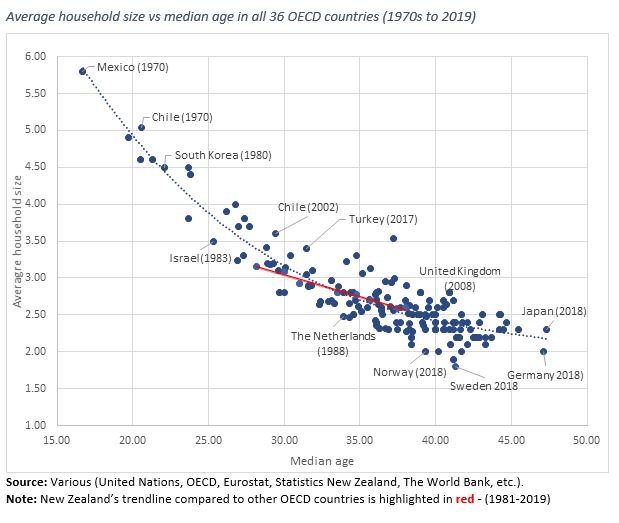
In New Zealand, the average household size has fallen from 3.2 in the 1970s to 2.6 in 2020 (like other OECD countries). According to Statistics New Zealand’s projections, it could fall even further in the next two decades or less.

So, are we gearing up to build the additional housing that our changing demographics require?

Policies that target land supply and infrastructure bottlenecks are key. However, the asymmetry of political and economic incentives between councils and the government has created a frustrating gridlock.

Growth and economic expansion in areas bring little revenue to councils but impose upfront infrastructure costs, such as water pipelines. This adds to councils’ reluctance to free up land for development.

Restrictions on density further add to housing supply issues.

The housing market is bad enough already, even without considering the effects of demographic change that will only worsen the problem. The government’s proposed policy responses must address the root of the problem rather than tinkering around the edges.

The housing shortage is worse than you’d thought

NZ Herald,

According to the OECD’s Building for a Better Tomorrow report, New Zealand now has the least affordable housing market for the poorest families. We have left more Kiwis with a slimmer chance of achieving the Kiwi Dream and exacerbated social inequality.

New Zealand’s housing is a national catastrophe. House prices have gone up by 37% nationally since 2015, according to ANZ. Shortages drive rising prices. And the problem will only worsen as an aging population means even more housing will be needed.

At a press conference last week, Prime Minister Ardern too called the housing market “unsustainable,” a U-turn from last year’s position of “sustained moderation” of housing inflation.

But the Prime Minister’s proposed solutions, thus far, have addressed the symptoms of the housing shortage rather than its root causes.

The Prime Minister re-launched the Public Housing Plan to build up to 18,000 social houses by 2024. Social housing is important, but would there be nearly as much need for it if a surplus of housing overall made for affordable rents? The barriers faced by private developers are also faced by government-led building initiatives, as Labour discovered with KiwiBuild.

Making it easier to build more housing in places where people want to live is the only thing that can solve a housing supply shortage.

While demand-side measures, like banning foreign buyers, can be tempting, they do not address the problem. The pandemic has done far more than any foreign buyer ban to curb housing pressure arising from overseas. International students and international visitors, each of whom needs a place to live while here, have largely gone away. Net migration has dropped to zero. But rents and housing costs are sharply up regardless.

Hopefully, vaccination programmes in 2021 can restore normality to the border. But even if the border remained closed forever, migration is only one part of growing demand for housing.  Demographic change and an aging population, all on their own, will also worsen the shortage.

An aging population, all else equal, requires more dwellings. And while those kinds of changes are incorporated in household projections by Statistics New Zealand, and consequently into Council forecasts of future housing demand, they are underappreciated in popular discussion of housing pressure.

Long-run demographic changes in household composition (such as from nuclear families to single-person households) and population ageing affect overall housing demand and require flexibility about the kinds of housing that can be built.

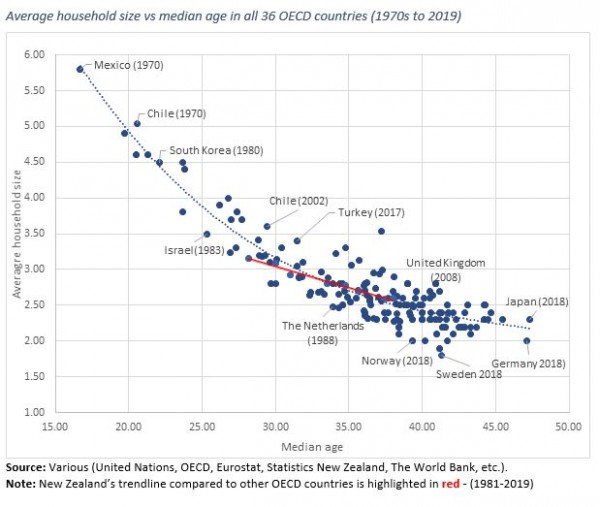
In New Zealand, average household size has dropped from 3.2 in the 1970s to 2.6 in 2020 (similar to OECD countries as seen in the figure below). It could drop to 2.4 in the next two decades or less, according to Statistics New Zealand’s projections. 

As family sizes reduce, median age increases along with demand for housing.

When the typical group of a hundred people consists of 20 couples, each with two young kids, and ten retired couples, those hundred people fall into thirty households. Thirty homes might be needed. When the hundred instead are 15 couples with two kids each, and 20 retired couples, 35 homes might instead be needed.

Aging populations require more homes for the same number of people.

The causes of the housing shortage have been reasonably well canvassed. Over decades, councils have borne the costs of accommodating more housing while central government enjoys the tax revenues that flow from growing cities – higher income tax, company tax, and GST revenues. Making it harder to build more housing has been one way that councils have sought to contain the costs of growth.

Years and years of restrictions on development have resulted in a construction sector scaled to the amount and types of building that have been allowed, rather than the amount and types of building that might be demanded by a growing and changing population.

The effects are stark. Housing shortages and high resulting housing costs undermine social cohesion. Families are forced to live in less pleasant and overcrowded dwellings, leading to deprivation, adverse health and social outcomes, and unstable environments for young children to grow and learn.

As of 2018, one in nine Kiwis were living in crowded housing, with Maori and Pasifika families most affected.

It will be impossible for the government to achieve promised increases in wellbeing without changing the fundamental direction of housing policy. But whatever your view on the best way of enabling more supply, the extent of the shortfall is larger when an aging population all on its own will increase the number of homes that are needed.

The government will soon be announcing its plans for remedying the problem. When thinking about the government’s proposals, ask yourself whether they enable more housing to be built, or whether they provide more tinkering around the demand side. Reform of the Resource Management Act will also be coming, but unless it improves the incentives facing Councils to enable more housing, it will not be as effective as it should be.

The housing shortage is bad enough already, even without considering the effects of demographic change that will only worsen the problem. Let’s hope that the government’s proposed policy responses strike to the root.

Who I am?

My first picture with the Initiative.

Introduction

Kia ora, my name is Leonard and I’m a Research Assistant currently based in Wellington. I’m in my second year with The New Zealand Initiative, one of the largest research organisations in the country. It’s a non-partisan think tank committed to creating a far more productive and better future for New Zealand.

We are the organisation to sketch pathways towards a better future. Our mission is to help create a competitive, open and dynamic economy and a free, prosperous, fair, and cohesive society.

I’m a 1.5 generation Kiwi-Korean and I hope to use my skillsets, knowledge and abilities to contribute to the intellectual debate in New Zealand. I began this webpage for people to follow my writings, blogs and commentary on political and economic affairs.

I have strong interests in urban economics, globalisation, international relations, political science, international political economy and self-help.

Please feel free to contact me on matters related to these subject matters.

Happy New Year and I hope you all have a great 2021.

Kind regards,

Leonard Hong

Why America matters – The Liberal World Order and New Zealand

“In recent years it has become evident that the consensus upholding this system is facing increasing pressures, from within and from without… It’s imperative that we act urgently to defend the liberal international order.” — President-Elect Joe Biden in 2017.

The Liberal World Order is one of the most used phrases in international relations scholarship. It’s a repetitive term, but a significant one, considering the fact that it affects everyone around the world. The United States began the Liberal International Order with the end of World War II and the defeat of the Nazis. With Franklin Roosevelt’s vision, the Western superpower set up international institutions and created long sustaining alliances for a greater multilateral and tolerant global society. Without the liberal world order and brilliant American leadership in the likes of Roosevelt, Eisenhower, Kennedy, and Reagan, New Zealand and other allied nations would have not been able to thrive during the Cold War period. Regional and international institutions such as GATT, WTO, IMF, the World Bank, European Union, and NATO provided security and economic cooperation among allied nation-states.

And yet, there are a lot of people in New Zealand that criticise America for its role as the leader of the world. In fact, many of them want to see its role reduced substantially. I agree with that statement somewhat, I’ve been very critical of their nonsensically hawkish interference in the Middle East, its naive attempts at forcefully spreading liberal democracy around the world. Its eastward expansion of NATO and the EU was also a great mistake that resulted in the military retaliation of the Russians. America’s neoconservatives and liberal hawks that were fundamentalist on the ‘end of history’ ultimately created all this mayhem.

However, if they mean America’s leadership getting entirely compromised and allowing authoritarian governments to enter that space – such as Communist China – then my answer is an absolute ‘no’. As President-Elect Biden noted, “it’s imperative that we act urgently to defend the liberal international order”. The Thucydides’ Trap is incoming at this stage in history and the US-China geopolitical contest will be the defining historical turning point for global liberal democracy. As John Mearsheimer noted before, this security competition will continue even under the Biden Administration and beyond.

So what is the point of this post? My message to New Zealanders in this blog is simple, America matters for the western world and in fact democracy itself. They have to win, and it is imperative that they do. I say this, despite knowing America’s complicated history.

In many ways, America is somewhat a hypocritical concept – it started as the first constitutional republic against the British monarchy. It set out laws for equal opportunity…but for only white men, and simultaneously set out a brilliant Federal system of power by instituting checks and balances. Constitutional amendments were made for free speech and inquiry… but also allowed slavery. It also intervened in smaller nations and participated as a colonial power during the Imperial era. Then slavery was banned under Abraham Lincoln, and racial equality was not legally achieved until the 1960s, under Lyndon Johnson’s Civil Rights Act and Voting Rights Act… and also escalated the Vietnam War. They defeated the Soviets and ended Communist authoritarianism with the Berlin Wall falling. The American Pentagon stupidly intervened in Iraq and Afghanistan after 9/11. Then elected the first African American President, Barack Obama (whom I personally admire). Then the recent events that happened in Washington is another example of historical irony at work. It is clear that President Trump and his cronies led the world to a more chaotic, less democratic and hyper-partisan society. America as the beacon of freedom or just arrogance? In short, both. The American experiment is indeed full of both hypocrisies and social progress. Even today, many social science scholars such as Cornel West suggest that the nation has not lived up to its ideals, for instance, the inadequacy of equal opportunity for all. These are all empirically and historically accurate.

However, what separates America in contrast to other countries around the world is that it’s the first serious societal experiment in human history. The United States is like the ‘Republic City’ in the television cartoon, The Legend of Korra. The nation is defined entirely by civic values rather than on race, ethnicity, culture, background, or creed. You become American by embracing its liberal democratic values, its identity based on its historical strife against the British monarchy, its constitutional values, and individual liberty. It’s a nation created out of migration and a sociological result as a historical derivative of European enlightenment.

Diversity matters to many Americans, but what is unique is the tolerance towards others, the ability to fight for freedom around the world. Liberalism is the key symbol of America and that’s the beauty of it. As Francis Fukuyama mentioned in his column last year:

Liberalism was simply a pragmatic tool for resolving conflicts in diverse societies, one that sought to lower the temperature of politics by taking questions of final ends off the table and moving them into the sphere of private life. This remains one of its most important selling points today.

Indeed, liberalism allows for diversity. Other liberal democracies like New Zealand, Australia, the EU etc, need the United States for the sake of soft power. America as a symbol is still a liberal democracy with its political institutions stable. Even though there has been a rise of neopatrimonialism in their political process which has undermined the state to be held accountable to its people. Rent-seeking behaviour among some plutocrats has undermined Americans’ trust towards its politicians and state institutions. We witnessed such examples through the 2008 global financial crisis and the federal government’s response to Covid-19.

Historically the United States has been a success story so far, but it needs to sort its own domestic affairs out. We already have incoming challenges such as AI, automation, climate change and geopolitical tensions, that will cause more drastic disruption to the world. But those challenges cannot be solved if America’s civil society and political polarisation continues. The world needs America to be the genuine liberal captain it was when it led the liberal international order after WWII. As liberals, we have to preserve our values of freedom, justice, equality and liberal democracy in the face of rising China and revival of national populism. We cannot continue this trend of a global ‘democratic recession’.

As a liberal democrat – in the classical sense – I’m hoping that the new Biden Administration would bring some common sense back in the White House. The Electoral College just confirmed Joe Biden’s victory in the 2020 US Presidential election – He will be the next President. It’s a sigh of relief for many (including me) after President Trump’s tumultuous, chaotic, and unpredictable 4-year term. Although I criticised the Democrats in a previous post, that doesn’t mean I don’t want to Biden Administration to do well.

They have a huge task ahead. The Liberal World Order and America matter to all of us.

Military Theatre

These days, even the German army cannot afford to neglect its green credentials. Pity if that’s the only thing it is good at.

German military manufacturer FFG just presented its latest tank. This is not your usual combat vehicle, not just because of its deep blue livery. It’s a hybrid.

The Genesis, as they call this beast, is a modern field general’s Prius. Except it runs on eight wheels, weighs up to 40 tons and has a 30mm automatic cannon. No Tesla can compete with that.

And it’s a technological miracle. The Genesis reaches speeds of up to 100 kilometres per hour. In silent mode, the only thing you can hear is the gun, and it can drive submerged under four metres of water.

The tank’s green credentials excite Germany’s military strategists. Pity that the rest of the German military is no longer fit for purpose.

The past decade has been terrible for Germany’s armed forces. And this time, it did not even lose a war. Hardly a week goes by without new absurdities from the Bundeswehr. It is hard to imagine how this country ever threatened anyone but itself.

A couple of years ago, only four out of 128 Luftwaffe fighter jets complied with NATO’s basic requirements. But that was still a better percentage than the German submarine fleet back then: all six U-Boats were out of commission.

Maintaining marine equipment is not exactly the Germans’ strength.

The pride of the German navy is a three-masted barque, the Gorch Fock. Though it looks like a relic from the Crimean War, it was only commissioned in 1958. It should have undergone a €10 million repair job in 2015, but five years and €135 million later, the Gorch Fock job is still unfinished.

The list goes on. Airforce pilots losing their licences because their helicopters don’t fly. Soldiers complaining they need to bring their own thermal underwear on exercises and deployments. And the army apparently only has enough ammunition for two days of fighting should the country ever find itself at war.

Maybe the Bundeswehr is just a sign of the times. It virtue-signals some modern values and guarantees that no country ever need to fear the Germans again.

Even their electric tanks would need to be recharged shortly after crossing the border.

The Demise of Excellence – New Zealand is falling behind

Introduction: 

One of the core cultural values I found quite hard to grasp in New Zealand is the inherent egalitarian nature of Kiwis. It shows that Kiwis are friendly, respectful, and courteous of others. Prime Minister Jacinda Ardern’s viral catchphrase “Be Kind” symbolically embodies our culture. However, are there potential negative consequences because of our egalitarianism? I wondered whether if it was why we have a ‘tall poppy syndrome’ problem.

As Dr Oliver Hartwich mentioned in his recent column for The New Zealand Herald, New Zealanders have a lax attitude towards excellence. Although, we have a few world-class sportspeople, business CEOs and others. But as a society, it seems as though we put more emphasis on equality rather than excelling in anything. I’ve personally witnessed this through the Kiwi nature of the ‘Yeah, nah, yeah bro’ attitudes towards life. ‘She’ll be alright mate’ is the common answer we raise whenever we face internal troubles or domestic difficulties. This has had unintended consequences across the country reflected in our economic and social outcomes. I think New Zealand has a broad cultural problem  if most Kiwis take a complacent attitude towards life, we will witness a further decline. This starkly contrasts countries that outperform us such as East Asian nations like South Korea and Singapore. 

Economic and Social Indicators: 

Our ‘average’ international rankings speak for itself. Our international education standards have fallen substantially in the last few decades. In PISA, our scores dropped for Maths, Science and Reading substantially shown in Briar Lipson’s book ‘New Zealand’s Education Delusion’. Our productivity gap between Australia has continuously widened closer to 20%. Our economy is still heavily reliant on primary industries and international tourism, despite being a developed economy. Our FDI restrictiveness is number one in the OECD. Our Universities are nowhere near the top 50 in the world (In contrast to our neighbours Australia, which have more than 5 Universities). There are other economic and social indicators that I could mention, but the reality is that if Kiwis continue to be satisfied with mediocre economic, social and government policies, then our whole society will ‘pay’ for such mediocrity in the long term. 

The Dramatic Turnaround of East Asia: From Developing to World-Class

Figure 1: Labour Productivity Levels Relative to the United States (%), 1950-2019 (S. Korea & NZ)

Internationally, countries in Asia (especially North-East Asia) witnessed a remarkable economic recovery beginning during the post-WWII period. Beginning with Japan’s industrialisation, the new four Asian Tigers – South Korea, Taiwan, Hong Kong and Singapore followed suit with the ‘flying geese’ model of economic development. Economists have coined these four countries’ world-class economic outcomes as the ‘East Asian miracle’. Coincidently, this contrasts starkly with New Zealand’s mediocrity witnessed in the last 70 years. 

Economist Dr Üngör of Otago raised this in his recent Newsroom column. As shown in Figure 1, South Korea’s labour productivity level was less than 12% of US labour productivity in 1950, but by 2019 it was 63%. New Zealand was at 92% of the US in 1950 but dropped to 62% by 2019. The figure provides a humbling picture for New Zealand – The South Koreans have overtaken New Zealanders and we are falling behind the best performers in the world today. Back then, New Zealand was once one of the few nations with one of the highest GDP per capita in the world, but since then we have faltered into a mid-tier economy. 

South Korea’s overlap of New Zealand should signal warning signs for New Zealand policymakers. The turnaround was possible because South Koreans built a prosperous nation by changing the cultural narrative towards competency, strived for excellence, and took greater communitarian responsibility towards long term prosperity. A similar change of mantra can be said about the Taiwanese and the Hong Kong people. 

My personal favourite example is the South East Asian city-state Singapore. With the brilliant leadership of Lee Kuan Yew, the nation went from a wasteland with no natural resources into one of the finest economics in the world. His style of government was highly technocratic. Singapore is very competitive, meritocratic, and pursues economic policies that were practical and results-driven. A combination of state-intervention and liberal free markets, it’s the fourth-highest in the world for GDP per capita. Not only is the country extremely efficient, but it is also environmentally friendly and clean. A perfect combination of sustainable development and world-class governance. Whilst the nation is regarded as a semi-democratic society, there are many things New Zealand can learn from Singapore’s system, institutional mechanisms and broad culture. Lee changed the mindset of the Singaporean people to strive to excellence and competence.   

Competent Response to Covid-19: South Korea and Singapore

In the earlier months of 2020, when Covid-19 hit the globe, the most effective responses were from East Asian states. I researched Taiwan, Singapore and South Korea during that period. They all had an exceptional public administration, competent execution of contact tracing, regular mask-wearing, mass testing of people and a well-mandated epidemic response team in their governments. These countries did well because they had a well-functioning society with the high-level expectation of competence and excellence. With these cultural factors in mind, they have world-class healthcare, government bureaucracies, a knowledge-based education curriculum and of course a competent response to Covid-19. This would have been impossible without having excellent administrators and a well-educated population. 

New Zealand’s Covid-19 Response: Mixed Bag 

New Zealand did very well responding to Covid-19 as well. However, I give much of the credit to our geographic proximity from the world. We were far away from epidemic centres such as China and Europe during the early stages of the pandemic. In addition, having Prime Minister Jacinda Ardern – not some of her Cabinet members – at the time was essential to keeping the public disciplined in our efforts to contain the virus. The lockdown was effective at stamping out the virus, but with an economic cost. Our Debt/GDP ratio is now projected to be 56% by 2026, despite beginning at 19.2% earlier before the national shutdown occurred. 

Although this global pandemic is unprecedented, if we had the ambition and the drive to stamp out the virus without a national lockdown, I truly believe that would have been entirely possible. Our border quarantine procedures are still mediocre at best – after more than 9 months of Covid-19  and blunders have caused the continuous resurrection of the virus in Auckland for the second time after complete elimination. It seems New Zealanders are ‘happy’ with the outcome without realising the combination of luck, public discipline, geographic proximity, and sound leadership. We have witnessed numerous examples of bureaucratic incompetence and administrative blunders in contrast to the East Asian states I mentioned before. Our contact tracing, testing, and border quarantine are still woeful in comparison. 

Confucianism: The Cause of East Asian prosperity? 

Perhaps some people might consider this East Asian trait of “excellence, merit and competence” as a broad Confucian phenomenon. Although Confucius himself did say: 

“The will to win, the desire to succeed, the urge to reach your full potential… these are the keys that will unlock the door to personal excellence.”

But I can’t entirely agree with the view that it’s just a Confucian phenomenon. Cultural change across societies depend on the decisions policymakers or what individuals themselves make. For instance, Japan industrialised as a result of forced trade embargoes imposed by the Americans under Commodore Perry which led to the prosperous Meiji period. Historical critical junctures and circumstances are what changes societal culture. 

The same thing can be said about the state of the Western world. Our cultural values have moved away from excellence towards equity. Previously, the West was leading the world on every economic, social and civilisational metric as indicated by historian Niall Ferguson. But now, the West – including New Zealand – are not as reputable as the past and the rise of Asia proves this declining trend. The West has lost the vital cultural component to its prosperity  The Weberian characteristics of work ethic, hard work and most importantly the strive for excellence. 

Conclusion: Cultural Rejuvenation is an Imperative

New Zealand needs to renew this virtue of competence, excellence and merit. Whilst egalitarian values are important to keep society strongly harmonious with good social cohesion and trust, it is imperative that we recover our prioritisation towards excellence once again. We see this with our excessive cultural obsession with diversity and inclusion. Tolerance and social justice values are indeed important, but without a prosperous and thriving domestic economy, these values mean nothing. We must rejuvenate our old virtues of excellence in New Zealand. Across our education standards and our economic performance in the last few decades, we have so far settled with mediocrity. 

The comparison and contrast between East Asian nations and New Zealand show us a few things. New Zealand is not good enough, we have been mediocre and sub-par at best across multiple performance indicators. We need to be more ambitious as a society for the long-run and we must rebuild our cultural values towards discipline, hard work, excellence and competence.  
Why the Housing Crisis in New Zealand?

It is clear that so far both sides of politics have failed to address the ongoing problem of housing unaffordability. It’s been more than five years since the leaders of both major political parties acknowledged the housing crisis. Now, it’s 2020 and housing has become even more unaffordable with prices increasing by 19.8% with the median price of $725,000. Despite Covid-19 ‘supposedly’ cutting aggregate demand, how on earth did this phenomenon occur? It’s caused by multifaceted reasons which I will explore by sections:

Migration and Foreign Investment – Not the core factor

There is a fundamental misunderstanding of the housing crisis. Many New Zealanders believe that migration flow and population growth are the core reasons for growing housing prices. On face value, that is correct. Growing demography does mean growing housing demand. However, this would not be a problem if the growing demand is matched by a growing supply. Anti-developmental sentiments from central and local government artificially restricted land supply and housing development. In fact, migration is critical to our prosperity (especially those that are young with high skills and educated). The housing crisis is a supply problem rather than a demand problem.

Foreign investment and speculation are also conjectured by many in the public as the cause of housing hyperinflation. This is also incorrect. Much of the housing inflation is caused by local New Zealanders purchasing property and spurring up demand. In fact, only 3% of housing purchases were from foreigners between January and February 2016. Whilst further should be done to see the extent of the speculation over a long period of time, such evidence suggests that the effects are minimal.

Housing Supply < Housing Demand = Price increase

The core reason for the housing crisis is simply because growth in demand has exceeded growth in supply. One of the core fundamental economic principles is supply and demand. Housing has become extremely expensive because we have not built enough housing in New Zealand to address growing demand. In 1974, New Zealand was building 34,400 annually. However, because of the oil crisis in the 1980s and our unsustainable fiscal position, new annual dwellings dropped to 15,000 in that era. The current government have made some changes that resulted in a growing supply with 24,100 houses built in 2019. We need to note that the population in NZ was 3 million and now just over 5 million. Population growth and demographic ageing do mean that there is consequently excess demand. My research paper released in the new few months will explore this. 

In the last three years, the current government has attempted to curb aggregate demand and expand supply with Kiwibuild. There has been progress with better infrastructure financing to aid local councils and important changes to the National Policy Statement on Urban Development. This removes unnecessary regulations that so far prevented intensification. On the negative side, the government passed new laws such as the ban of foreign buyers (with the exception of Singaporeans and Australians), extended the bright-line test to 5 years, amended the Overseas Investment Act, and tried to legislate a new capital gains tax. For supply, Kiwibuild was a colossal failure with only 548 houses being built. There has been some definite progression in contrast to the previous government, but also multiple failures.

The Reserve Bank’s Impact in Housing

The global Covid-19 pandemic has forced many central banks around the world towards expansionary monetary policies. The Reserve Bank of New Zealand (RBNZ) is no exception. Under Adrian Orr, the bank committed to $100 billion of quantitative easing and also cut the OCR rates to 0.25%. This is unprecedented regarding the scale of the policy (a third of our GDP). These two decisions alone will raise the returns from investment in housing and increase pressure on house prices. Low-interest rates mean cheaper mortgages incentivise investors and consumers into the housing market. These policies led to higher equity and asset prices. Although, some of their policies are completely understandable considering Covid-19’s impact on employment and the economy. However, regardless of the pandemic, this level of quantitative easing is unprecedented. Saying this, it is undeniable that RBNZ’s policies have made a significant contribution to greater aggregate housing demand.

Lacking incentives for local government 

One of the key reasons for the current state of the housing market is because of poor local government incentives. Much of the infrastructure financing is imposed on the local councils, meanwhile, the revenue is centralised to government officials in Wellington. The current system gives far too much political leverage for those in central government, rather than allowing local officials to make important decisions on urban development. There are questions on whether the centralisation of such power into a larger government institution such as the Super City of Auckland Council led to efficient outcomes.

New Zealand’s current system does not incentivise local councils to grow but slows down development. Local government officials don’t want more people in their area, because that means greater demand for water, schools, housing, local parks, and other public infrastructure to accommodate growing demand. Meanwhile, the central government does not allocate funds based on proportionality, but rather on ‘democratic means’ of serving respective electorates and other political factors. The finance gets imposed on the councils with growing demand, but not given the finance from the central government. For example, more than 40% of newly arrived migrants settle in Auckland rather than other regions that need people. Auckland Council currently has growing debt and it wants to tackle that problem rather than expand urban development outwards. The same applies to many other local councils across the country. Without sufficient revenue provided by the central government, why would they want to grow? They would not want to free enough brownfield nor greenfield areas for housing development because all the costs are imposed on them.

To address these problems for New Zealand’s local governments, I advocate for ‘localism’ as it provides greater political leverage to local governments and decentralises decision-making. Countries such as Germany and Switzerland follow this form of local administration. In the United States, Houston in Texas also has a very decentralised governance system. At the federal level, they simply set out basic regulatory frameworks and for the implementation of policies, they leave it to local councils.

For instance, let’s take the case of Essen and Dortmund – the two regions have a competitive and cooperative governance arrangement. The reason is that the tax revenue created is tied to the number of residents in their area. It is essentially a form of a ‘means-test’ requirement for local officials to get their revenue. Because of the incentives to have more residents in their area, the government understands that they need to have good institutions, a clean and green environment, affordable housing and sound public infrastructure. the two cities needed to allow enough land supply available in their area to deal with growing demand. If certain residents leave their regions, they lose tax revenue consequently. In essence, a solid local structure that incentivises competition. Currently, both Essen and Dortmund have affordable housing. Since the 1980s, prices have only risen by 10% in the last 30 years. Simply by changing the tax incentives with a decentralised local government system, it leads to more optimal urban development that matches growing demand with sufficient supply.

Germany’s economic system is a strongly Keynesian-oriented system with high levels of taxation, a generous welfare system and a decentralised form of governance. Localism is neither a right nor left policy subscription, but an example that has worked in these areas. Experimentation in New Zealand wouldn’t be a bad start and we can learn from these international examples. I am not advocating for the de-amalgamation of Auckland Council, but rather changing the tax structure so that local councils get the incentives. Decentralisation of command towards district councils, for instance, is a potential alternative without removing the Super City’s institutional arrangement. As stated by renowned American investor Charlie Munger stated,

“I think I’ve been in the top 5 per cent of my age cohort all my life in understanding the power of incentives, and all my life I’ve underestimated it.”

Basic economics is about incentives. Incentivising local government to grow public infrastructure and push for housing development requires the officials to have the incentives. This will help the expansion of supply – both housing and infrastructure. 

Conclusion

These are the many reasons why housing is unaffordable. Housing is an extremely complicated subject but this post attempted to explore fundamental factors as to why house prices increased in New Zealand despite housing demand ‘supposedly’ very low under the current era of Covid-19. It is clear that housing supply has not expanded fast enough to accommodate growing demand. RBNZ’s policies have exacerbated the problem fueling investment into the property market, and the current set-up of local governments prevents them from wanting to expand development because most of the costs are imposed on them, rather than the central government.

It is imperative for the new Labour government to push for the expansion of housing and land supply rather than continuing to just curb growing housing demand.

Picture of Houses in Suburbs.

The Democrats have been hopeless

It was in 2016 when I first watched and observed the outcomes of a US Presidential election. I detested Hillary Clinton back then – I still do now – but I didn’t expect Donald Trump to win, yet he did. Following on from Brexit, this was another shock to the American Establishment and symbolic of the rise of national populism. Back then, I was a hardcore social democrat, and I was disappointed and sad that America lost the opportunity to elect a 21st-century version of Franklin Delano Roosevelt, Bernie Sanders. I consider myself a moderate centrist today, but that’ll be discussed in another blog post.

The world witnessed four years of a Republican White House and boy it was a period of pure entertainment and a complete mess. Now it’s 2020 and the Democrats have selected an old, weak and out of touch politician – Joe Biden – as their candidate. Throughout 2019 and 2020, I felt that the liberal establishment learnt absolutely nothing from 2016, and it shows. Despite the polls suggesting that it will be a landslide for Biden, they were completely wrong. The US election is still an ongoing dispute and it is still too close to call for either of the candidates. The rustbelt states such as Michigan, Pennsylvania, Wisconsin have moved back towards the Democrats, but only because of Trump’s incompetency regarding Covid-19. They have lost seats in the House and also the Senate is in the strong hands of the Republicans. If Trump didn’t have to deal with Covid-19, the President may have indeed had a landslide victory against Biden.

The question is why did the Democrats perform so poorly despite the expectation? The Americans have faced a period of complete chaotic governance by the Trump Administration but many still voted for him. The fact of the matter is that many Americans are sick and tired of political correctness, wokeness, and identity politics. And this is taking into account Trump’s disastrous policies. Many people including Sam Harris, Andrew Sullivan, Eric Weinstein, Paul Graham, and Niall Ferguson and others have previously warned centre-left people about this form of politics.

One prominent scholar that understood this problem for the Democrats was Stanford’s Francis Fukuyama. He covered this topic of identity politics in his book, ‘Identity: The Demand for Dignity and the Politics of Resentment’. The core thesis of the book surrounds the concept of ‘thymos’. Fukuyama described it as “part of the soul that craves recognition or dignity.” Fukuyama says that the thymos of blue-collar, white Americans was not recognised by the political and economic establishment in America in 2016. The craving of status and recognition is not a new phenomenon, which is evident from the cultural movements of the 1960s – the civil rights movement of African Americans, Women, LGBT, and even the environmental movement. These movements were legitimate and necessary but extended far beyond its necessity up until 2016. Because that sense of dignity was ignored by the Democrats, but recognised by Trump in the form of nationalist sentiment and protectionist economic policies, they switched to him. Even with his racial rhetoric, many didn’t care, they were just glad someone wanted to talk about the negative externalities caused by globalisation. The former core of the Democratic Party was on socioeconomic issues, but it moved on entirely into cultural matters, even in 2020. 

Another scholar regarding this is Charles Murray. His book ‘Coming Apart: The State of White America, 1960–2010’, explored the economic consequences of globalisation and how there is a growing gap between white working-class Americans and the urban white-collar class. The sad state of working-class America was largely ignored by the liberal establishment. The state of white America is increasingly divided along economic lines, not cultural lines. The Democrats didn’t even talk about this topic in 2016, nor did they refer to it in 2020. The Party has taken the votes of traditional blue-collar Democrats for granted.

Hence many former voters of Obama switched to Trump. This is why they lost 2016, and may only just marginally win 2020 because of Covid-19. Instead of trying to legitimately deal with the adverse consequences of globalisation, and help those people that lost their jobs to China and Mexico, their mantra was focused on intersectionalism, transgender bathrooms, and the dangers of white supremacy. Think about it, if you are a former worker of a manufacturing factory in Pennsylvania, and you lost your job, got divorced and on unemployment benefits, and the Democrats are talking about 50/50 quotas, gender pronouns, refugee rights, global governance and so on – you would feel politically unrecognised. They ignored the former core base that has voted for them from the 1930s to the 1990s. The embodiment of woke politics is symbolised by Democratic politicians like Stacey Abrams, Kamala Harris (the unlikable Vice-Presidential candidate), Alexandra Ocasio-Cortez and others.

George Mason University Professor Alex Tabarrok’s Tweet sums this phenomenon quite well:

My takeaway is that a large number of people HATE the cultural left (not the econ left) and are willing to put up with almost anything, including incompetence, chaos, corruption and bad policy, to signal their views loud and clear.

The Democrats need to move on from identity politics and move back to the core economic issues of our time – this also applies to the New Zealand Labour Party and the Greens by the way. The world is witnessing the rise of a new technological revolution and developments in Artificial Intelligence and automation. This will disrupt the international labour market significantly. This will be far more pervasive than the Industrial Revolution and exponentially more consequential. We also have global warming and climate change that requires vigorous economic and scientific analysis to legitimately solve this international problem. We also have an ongoing geopolitical competition with the West and China. Are Democrats taking these challenges seriously? In my eyes, the answer is ‘No’. The economic left of the party needs to regain control of the narrative and the cultural left need to understand that this style of woke politics will drive more voters towards the right. There is a legitimately strong case for competent centre-left politics that can try to correct structural dislocation of manufacturing work and increasingly precarious jobs (including repetitive white-collar jobs too). I see politicians such as Andrew Yang and Tulsi Gabbard as the potential embodiment of the Democratic Party’s future (coincidently they are American minorities as well).

The Democrats have so far been absolutely hopeless. Regardless of what the 2020 election outcomes will be, they need to take socioeconomic issues far more seriously. As a fan and admirer of the United States, I hope they sort their domestic affairs out.


Riding into the political sunset

Winston Peters will exit politics for the third time in his career. I spotted his ghost at Parliament the other day. He looked unusually grumpy.

Maybe it was just my hallucination, but after decades of observing him it was incredibly lifelike. After all, his mannerisms have become predictable. So, I sidled up to the apparition and asked if he found the election outcome a bit depressing.

“No, no. No, no. No, no. There’s no need for you to go into a fit of gloom and doom at this point in time,” he replied curtly.

Ok. But perhaps he had some thoughts on Ardern’s campaign?

“Can I finish? Can I finish? Look, Mr Hong, you’ll do much better if you listened for a second.”

I began to apologise, but he must have thought I was interrupting — “No, no, no, no, stop right, stop right there. Stop right there, Leonard.”

Instead of carrying on, he just glared at me. After a few moments I asked if this was the true end of his political career.

“Look, look, this is just now speculating on what neither you or I or anybody else, including the experts, could possibly prognosticate this far out.

“Why would you make a statement like that? Try and be neutral and unbiased. If you are going to ask questions back it up with some certainty.”

Now I understood what it’s like to be a press gallery reporter. Poor things.

“I’m not giving you my comment on that,” Peters continued. “But I do believe in a thing called commercial accountability, as we also believe in political and journalistic accountability.”

I gave him one final chance to say something nice to say about David Seymour and Gerry Brownlee.

“If Nelson Mandela can walk out of Robben Island after 27 years and forgive his oppressors, so can I.

“I could’ve been the Prime Minister years ago if I was prepared to suck up to the right-wing ideology for the National Party. I think that we’ve covered the subject as comprehensively as we can possibly do it.”

I raised my eyebrows. Again, he must have thought I was about to ask a question.

“I’ve got a message for my friends in the media, and it’s all bad. Most of them have been arrogant, quiche eating, chardonnay drinking, pinkie finger-pointing snobbery – and fart blossoms.

“I have never heard such obsequious, subservient grovelling, kowtowing, palm-kissing nonsense.”

And so, the inimitable, Right Honourable Winston Peters walked into the political sunset. Generations of journalists will miss his wordy ways of not answering questions.

We wish him unexcited calm in retirement. It would be a New Zealand First.

Third Option for the International System – Rodrik and Walt

With the ongoing Covid-19 pandemic, the Sino-American relationship is worsening. Tensions are heating as President Trump recently imposed sanctions on China’s largest chipmaker, SMIC.

American actions are becoming a self-fulfilling prophecy towards direct conflict. The world is getting closer to falling for the Thucydides Trap. As foreign policy experts continue to reiterate the inevitabilities of a New Cold War, will conflict be the destiny of the two great powers?

Harvard’s Stephen Walt and Dani Rodrik offered a third alternative in their paper ‘Constructing A New World Order’. The aim is to set an international institutional framework that creates as much stability and cooperation as possible.

First, the authors reject the ‘deep integration’ goals of the liberal internationalists. Rejuvenating multilateralism and hyper-globalisation are well-intended policies. But it creates unintended consequences that undermine the economic stability of western liberal democracies. China would also be unwilling to further integrate into the global trading system from its state-led developmental model.

Second, they disregard the hard-line hawkish approach advocated by the Trump Administration. The current decoupling strategy against China creates ‘beggar-thy neighbour’ effects on other nations. This also prevents mutually beneficial cooperation occurring with the Chinese, especially regarding global public health, improving nuclear security, and addressing climate change.

The goal is setting a pragmatic and realistic approach within the Sino-American relationship. The international system should allow the nation-states to set their own foreign and economic policies.

There are four categorisations of policies that fit within their institutional theory. There is Universal Agreement; Cooperative Negotiations; Autonomous Policy; and Multilateral Governance.

Indeed, Walt and Rodrik’s ‘Modus Vivendi’ international system is a pragmatic institutional mechanism. But, can Uncle Sam stay committed to mutually beneficial cooperation and reduce the risk of falling for the Thucydides Trap?

The Sino-American competition will shape the next few decades of the world order. As both powers strive to compete for power and international influence, the goal for the world is to keep the competition away from a hot war within bounds.

Institutionalising a set of rules on foreign and trade policies could help assuage great power politics. This could also incentivise foreign policymakers from both sides towards restraint as both a peaceful international order and continued globalisation is critical for small powers like New Zealand.

The leaders of the two great powers in the system are two egomaniacs. Their recklessness may make a third alternative for the international system as impossible. But let us hope for the best.