Yes, there is intergenerational inequality on Housing

House prices have risen to all-time highs. According to the Real Estate Institute of New Zealand, prices have risen by 30.6 percent in the last year. We’ve seen record high housing prices for fourteen months in a row.

A housing crisis? It’s more accurate to call this as a “housing catastrophe.” For many young people, attaining the Kiwi Dream is now close to impossible.

Anecdotally, there have been many reports of growing intergenerational inequality between the young and the older generation because of continued price inflation. Is this, however, supported by empirical evidence?

According to Statistics NZ, the average annual income of today’s Generation Z is $45,188. In 1998, the average annual income for Generation X was $22,256. In nominal terms, incomes have merely doubled.

Conversely, national median house prices have risen from $164,167 to $826,000 over the same time period. Prices have soared by fivefold. Prices in Auckland and Wellington are approaching $1 million.

In 1998, house prices were about 7 times the gross income for Gen X, today for Gen Z, it is 18 times. Buying a home today is significantly more difficult for Gen Z than it was for Gen X in 1998.

According to Demographia International, from the late 1950s to the early 1990s, the median property price was only two to three times the average annual household income. This figure is now 8.6.

As far as housing is concerned, the data shows that our parents and grandparents had it far easier than Generation Z today.

Back then, it was possible to buy a home with just a single source of income. Today’s couples and spouses must both work to cover their housing cost, whether that is rent or a mortgage.

It may be true that the older generation had higher mortgage rates due to higher interest rates during the 1980s. But mortgage rates have little bearing on the affordability of a home. Even though new buyers today may face trouble with higher interest rates later.

House prices at all-time highs are detrimental to our economic prosperity. A more affordable housing market with lower rent prices is associated with greater social mobility. So far, this tradition has dwindled.

For a variety of reasons, housing affordability has deteriorated. Restrictive planning laws, poor incentives for local councils, local obstructions to urban development, and the Reserve Bank’s monetary responses to Covid-19 fuelled the fire. However, the main reason for this is a lack of housing supply.

House prices have skyrocketed, preventing young people from realising the Kiwi Dream. It’s time we change that.

Clarke and Dawe in 2021

My article in the week’s Insights newsletter. It is a #3, the third item in the newsletter which is always an attempt at humour. You can sign up to our weekly newsletter here.

One of the finest shows on economic affairs was ‘Clarke and Dawe’. The two satirists collaborated from 1989 until John Clarke’s death 2017. If only this partnership were still around in the era of Covid-19 and quantitative easing. I miss their satire.

So how would Clarke and Dawe explain the current global economic recession today? I wonder…

BD: Thanks for joining, you’re a macroeconomist, correct?

JC: A pleasure to be here. Yes, I am indeed.

BD: As a response to Covid-19, quantitative easing (QE) was used by central banks. How does it work?

JC: Well, it starts at a desk in a central bank. You take the computer out of box, press buttons, click enter. You alert the banking sector and the Treasury, send both an email, and press copy. You buy bonds and send money.

BD: And why did central banks start QE? Isn’t that ‘counterfeit money’? You can’t just print money at will.

JC: They print it digitally. You press buttons with more zeros on the computer – Boom! New dollars, just like that. It’s a free ATM machine, just bigger.

BD: But there is no free lunch, though? What are the financial implications?

JC: Potential inflation, consumer prices could go up. The more money you print like Zimbabwe, the poorer you become.

BD: What do macroeconomists do?

JC: We talk about economics without stories. It’s up, down, left, or right for unemployment, CPI, inflation, GDP etc. Straightforward, really.

BD: Correct, and what about government debt globally?

JC: They’re broke. Particularly the Europeans, the Japanese, and the Americans. Debt levels are above their entire annual economic output.

BD: Right… so what does that mean?

JC: No money. Broke economies were being lent money by other broke economies, but now they are all broke. The only lenders are central banks. It’s a last resort, so to speak.

BD: My goodness. The digital printer machine is out of control, and governments are broke. What’s the next step you think?

JC: Another bail out from central banks, probably. And then a bail-out of the central banks, most likely by themselves.

BD: Correct, an ongoing merry-go-round. Is this sustainable?

JC: Yeah, we might as well be entering clown world.

BD: Correct. That’s a grim end to that story. Thank you for your time.

JC: My pleasure. Oh, I better check the gold price. And where did I leave the key to my safe deposit box?

Mr John Clarke — Clarke & Dawe
Clarke and Dawe

The Hell of Good Intentions – Climate Change

Far too many times across history, I’ve seen and read about policymakers causing blunders. At every step, most people utter the claim that they have ‘good intentions’. Well, as Samuel Johnson quipped, “hell is paved with good intentions”. This applies to both sides of politics.

We see the classic example on climate change. Indeed, we have the moral obligation to do everything we can to lower our emissions and achieve net-zero by 2050 (the earlier the better for me). The centre-left so far failed despite the good intentions, and the centre-right under National refused to put the agriculture sector into the ETS (explained later).

The centre-right did very little with the global issue when they were previously in government. Under the National government (2008-2017), the Emissions Trading Scheme (ETS) prices dropped with a ‘flexible’ cap, not binding like now; NZ maintained the status quo for climate change. The agriculture lobby within the right of politics made the sector exempt from the ETS. This was a problem and still a problem for those that want lower emissions as efficiently and effectively as possible.

Nor have the current centre-left government made much progress. What really frustrates me is that both the Climate Change Commission (CCC) and government failed to make empirical cost-benefit assessments. According to Stats NZ, our emissions have not fallen but increased by 2% in 2018-2019. This is criminal. Our net emissions are actually set to increase, not decrease. Why?

Let’s start with the oil and gas exploration bans. This caused ‘substitution effects’ in the market – where one consumption of a good gets replaced by another due to higher costs. Consequently, we have a record high imports of coal into the country. The passage of the Zero Carbon Act in Parliament means nothing when we are failing to reach our targets. The energy market shifted towards alternative resources that emit more carbon dioxide in the air.

To give some credit, some good policy mechanisms have been introduced, primarily under Climate Change Minister James Shaw. We have a binding emissions cap within the ETS. This follows basic economic logic – having a binding carbon tax, or ETS, is the simplest and fastest way of lowering emissions. According to the Pigou Club – with renowned members such as Joseph Stiglitz, Daron Acemoglu, Kenneth Rogoff, Greg Mankiw, and Paul Krugman – such a scheme corrects market externalities. Fortunately, New Zealand leads the way with a binding cap now.

The starting point and main tool in lowering emissions should be with the ETS, not government pet projects. Spending millions of dollars on EVs and other government-led projects do not reduce our net emissions overall. It simply allows other market players to purchase carbon credits that will pollute anyway. If the government decides to lower its emissions, other people can pollute more because of the binding cap. According to Professor Hazledine from Auckland, the CC has not made it clear whether we are sticking with the ETS or a carbon tax. We should focus on improving the ETS and finding other technological, urban planning and public transport solutions to lower emissions.

Free trade agreements with a sustainable development framework is excellent too – Switzerland and Peru signed one with the first ever ‘carbon offset scheme’ which lowers net-emissions between both sides by finding comparative advantages of their respective economies. Peru finances sustainable development projects in Switzerland and takes credit for emission cuts.

Climate change is a global issue and requires our country to play its role. Efforts from all of us, but primarily the largest emitters such as China, the US, and India are also imperative – we live in a global village and all our actions have consequences. New Zealand is a responsible stakeholder in the international rules-based system. I remind people that we must stop becoming doctrinaire to the government’s intentions and focus on the effectiveness of the policy.

Lower emissions with cost-effective policies should be the goal. For example, imagine sending your broken car to a repairer, and he fails. Would you be happy if he gave you excuses and just said “I tried and I had good intentions”. You’d be like, “screw that, do it again, and get it fixed properly”. Similarly, good intentions mean jack-all when it comes to climate change. Some good work has been done, but a lot of the policies that have recently emerged will do very little to lowering our emissions.  

This is why fighting climate change is so urgent | Environmental Defense  Fund

“Invert, always invert.”

Recently, someone told me that my method of thinking drastically transformed. To be frank, that’s correct. I’ve become far more focused on empirical analysis of public policy and business. I’ve attempted to abandon ideology in ways of analysing problems and looking at them from different angles.

Renowned American investor Charlie Munger stated that we should “Invert, always invert: Turn a situation or problem upside down. Look at it backwards”. It is indeed a curse to be fundamentally ideological. It traps us from being able to solve problems practically. Unfortunately, many of us have fallen into this psychological fallacy.

In relation, people debate about whether the world is a social construct or an objective universe. How humanity is not entirely an objective place simply determined by facts and numbers. From my angle, both have important perspectives. Humans provide meaning to objects that create subjectivity within our observation of the world. Simultaneously, if you ignore facts and data, and only consider the intentions of people, we are being ignorant.

This is where I’d like to introduce the idea of the ‘half-glass empty/full’ analogy. The way you look at it determines how you subjectively view this object. A cup that is ‘half-empty’ sounds pessimistic albeit correct. ‘Half-full’ is optimistic but also sound. The thing is that both are empirically and logically objective, except the approach to the observation. I tend to view this as a good analogy of explaining the difference between liberals and conservatives; the utopian vs the constrained; yin and yang.

For example, let’s explore the hypothesis of income and wealth inequality (caused by hyperglobalisation). It’s objectively true that since the 1980s, the world has become both more unequal and equal – in different ways. According to Brookings, inequality between countries have gone down and 3.8 billion people have exited extreme poverty. Simultaneously, inequality within countries has gone up as countries became globalised, accelerated by lower tax rates, free trade and creative destruction of economies, fostered by technological innovation. This has unfortunately led to greater populism across western liberal democracies.

The point is that what we witness around the world is not as black and white as people think. On net balance, globalisation has been a fundamentally important part of human prosperity (Pinker, 2018). But the real problem is that policymakers have failed to consider the short-term unintended consequences of globalisation.

Therefore by inverting a problem or hypothesis, we can become better thinkers and participants of society. Consider different perspectives as a thought exercise. Don’t fall into the trap of political or philosophical ideology. Genuine empathy of different thought processes and intellectual curiosity can solve many of the world’s problems.

Get rich with Dogecoin

Recently, you have been really responsible with your finances. You stopped buying chicken paninis, cut back on the flat whites, and eating out at KFC. You put more money into a savings account.

Unfortunately, the reward for being financially frugal is a meagre 0.8% per annum of interest. After 2% inflation, you are losing money.

Not very satisfactory.

But, if you cannot build some long-term wealth in the bank, what else can you do?  

Well, let us explore a few options.

You could try housing. However, you’ll need to get a new mortgage and a substantial amount of deposit. It is also costly, with the average house price now exceeding $800,000. And that will only provide you with a 30% return within a few months.

But what if I told you that you could make a 900% return, no a 11,000% return in the same period?*

How about investing in Dogecoin! Yes, that meme dog cryptocurrency.

It started in 2013 as a joke Bitcoin alternative with a caricature of an innocent Japanese Shiba-Inu dog as its symbol.

Then, this year in February, Elon Musk tweeted about it, and Dogecoin took off to the moon.

A dollar invested when Elon tweeted is now worth $17.4 – Oh wow.  

Dogecoin is now worth $80.5 billion – worth more than companies such as Ford Motors, Honda and Adidas. Dogecoin was a joke about cryptocurrencies, but in an ironic twist, it became a wealth-creating digital asset.

In April 2021, a man named Glauber Contessoto gained notoriety for becoming a Dogecoin millionaire. We are supposedly living in a completely new era of unorthodox wealth creation.

Or perhaps it’s just a bubble. During the 1600s in Holland, multicoloured tulips became prized possessions. “Tulipmania” saw prices go crazy until it burst into nothing of substance. 

The folly of human speculation has always been there.

My generation particularly loves bubbles – look at GameStop, for instance. You can profit and still get a decent result on investment by selling at the right time.

No need to be financially responsible. Eat out, buy KFC and spend your remaining funds on the latest Dogecoin.

It will be fine as long as you are the last one out before the bubble bursts. Just short it. Easy peasy.

*Not investment advice

The Theory of Human Stupidity

Humans are complicated. We are intelligent species that dominated the world with our knowledge and brilliance. We built pyramids and skyscrapers, we went to the moon, and we invented Pokémon GO.

Yet, throughout human history, human stupidity has triumphed time and time again – whether it is communism and fascism killing millions of people, recurring asset price bubbles and their eventual bursts, or carelessness leading to environmental degradation. We never cease to stop causing unnecessary harm to ourselves or others.  

Stupidity applies on an individual level, too. We have dozens of cognitive biases, believe our own lies and feel good about it.

But is there something more systematic about human folly?

Italian economic historian Carlo M. Cipolla believes so. In his book ‘The Basic Laws of Human Stupidity’, Cipolla identifies four different kinds of people – stupid people, helpless people, intelligent people, and bandits.

As a group, stupid people are far more powerful than the Mafia and the Military-Industrial Complex because they actually drive and influence social outcomes. 

Cipolla found that the same proportion of people in any group tended to be stupid, even within the group of Nobel laureates or professors, or even blue-collar workers. The reality is that we have to face the same proportion of stupid people, no matter where we go or travel.

Everyone underestimates the effects of stupid people in action because it is not apparent. As a result, non-stupid people underestimate the damaging power of stupid people.

Intelligent people benefit themselves and society; bandits steal from others to benefit themselves; helpless people are exploited for their naivety despite contributing positively to society. However, stupid people are counterproductive to both their own individual and society’s overall interests.

Cipolla says that a stupid person is far more dangerous, especially if the individual was born into the elite class. Their total damage capacity is infinite within their potential position as bureaucrats, generals, and even politicians.

As stated by Yuval Harari, history teaches us that people must never underestimate the role of stupidity in human history. It is one of the most powerful forces around the world.

We cannot trust human decency and supposedly good human leadership to do what is best for humanity. We can only hope that is the case, but stupid humans could win at the end of the day.

The Basic Laws of Human Stupidity by Carlo M. Cipolla - Penguin Books New  Zealand

Kiwi Dream? More like a nightmare

Last week’s Covid cases in Auckland delayed Finance Minister Robertson’s housing policy announcements. The housing shortage has been at crisis levels for a long time, but the delay in this case is not likely to make any difference.

The government has hinted that further tinkering on the demand side is coming, but enabling more building is what is needed.

Demand-side initiatives from both National and Labour-led governments have failed to address the underlying shortage, so house prices continue to rise.

If homeownership is part of the Kiwi Dream, we are deeply into nightmare territory instead.

And the problem is worse than you probably thought.

The Initiative’s new report, The Need to Build, discusses the relationship between population ageing and declining household sizes. Places with older populations require more and different housing than places with younger populations. As New Zealand ages, the housing shortage will worsen. The trend holds both here and across the OECD.

The problem is hardly unknown. Statistics New Zealand and local councils already consider declining household sizes when estimating housing demand. But it is underappreciated elsewhere.

We projected new housing needs for 2038 and 2060 – the numbers are striking.

Even if the the border stayed closed for the next 20 years, we would still need to build at least 20,000 new net dwellings every year to meet demographic changes.   

For the six most realistic scenarios in the report, from 2019, New Zealand will need to build between 26,000 and 35,000 net dwellings – above and beyond the replacement of decrepit houses –  every year until 2038, and between 15,000 and 29,000 per year by 2060.

But we also have a current shortage of some 40,000 homes that also needs to be filled. There has not been nearly enough building for well over a decade. While the current construction boom has brought consenting numbers to the highest level since the 1970s, consenting rates are only a little above long term averages.

Population ageing adds fuel to the fire.

The Kiwi Dream for younger generations – Millennials and Generation Z – is slipping further away. Shortages mean high rent and little disposable income after housing costs. Continuously tinkering with demand policies such as the LVR, bright-line tests, and first home buyer programme will do little to make housing more affordable. 

The government must switch priorities to rapidly free up housing and land supply, or find ways to incentivise councils to be more pro-development.

Report: The Need to Build – The Demographic Drivers of Housing Demand

Leonard Hong

The political ‘buck passing’ of the responsibility for unaffordable housing by successive governments in New Zealand has created extremely expensive housing markets in cities such as Auckland and Wellington – and a national housing crisis. Auckland is the sixth least affordable city among 92 major global housing markets, according to the 2020 Demographia housing survey. The real price of housing in New Zealand increased by 171% from 2000 to 2019, compared with just 11% in Germany in the same period. Despite former Housing Minister Phil Twyford’s reforms, the government has prioritised supressing demand and targeting financial speculation from overseas. Demand-side solutions are just tinkering at the edges of the problem. Long-term demographic transformations and changing household sizes are affecting overall housing demand. Inflexible housing development is the core problem, and only freeing up enough supply can solve our housing unaffordability and overcrowding.

The projections in this report show that our housing problems are set to worsen. From 2019 to 2038, the annual average additional dwellings needed will increase from 26,246 (‘low’ migration and ‘low’ fertility) to 34,556 (‘medium’ migration and ‘high’ fertility). From 2019 to 2060, we will need 15,319 (‘low’ migration and ‘low’ fertility) and 29,052 (‘medium’ migration and ‘high’ fertility) additional dwellings annually. These figures do not take into account the annual demolition and replacement rate of dwellings and the current undersupply of 40,000. Since 1992, New Zealand has added only 21,445 net private dwellings annually to the housing stock. We are simply not building enough to meet the looming demographic changes and demands.

Our housing needs are also set to rise much faster than population growth. The average annual number of dwellings needed based on just projected population growth, excluding the smaller household size, was between 5,452 (‘low’ migration and ‘low’ fertility) and 21,543 (‘medium’ migration and ‘high’ fertility) to 2060 in our analysis. The difference represents an annual shortfall of 9,867 dwellings for the former and 7,509 for the latter (or 64% and 26%, respectively). This means housing policy using only projected population growth will markedly underestimate future demand.

Covid-19 and the Reserve Bank of New Zealand’s monetary response to the ongoing recession has led to much financial capital flowing into the housing market. Consequently, the national house price average reached $725,000, an increase of 19.8% from October 2019 to October 2020. Low interest rates created incentives for greater borrowing and investments in real assets such as financial stocks and housing. However, if sound institutional arrangements were established and growing supply could meet growing demand, there would be far fewer speculative incentives.

Local councils and Statistics New Zealand already factor demographic changes in their household and dwelling projections, but the effect of the average household size on housing demand is rarely discussed in the public sphere. The aggregate housing demand is based not just on population growth, but also the composition of each household. With household sizes shrinking, fewer people living with many children, and population ageing, we have ‘empty nests’ and ‘crowded houses’.


For this report, we calculated long-term population numbers using the demographic software Spectrum. Based on three fundamental factors – net migration, total fertility, and life expectancy – 36 scenarios were projected to 2060 (and 2038 for dwelling projections). In 33 out of the 36 scenarios, New Zealand’s population in 2060 will be larger than it is today. Under all 36 scenarios, the median age will be higher. The 36 scenarios were further narrowed to the six most plausible based on New Zealand’s recent demographic history. Among the six, the variation in median age and population size by 2060 was vast – the projected population ranged between 5.55 million and 7.26 million, while the median age was between 41.0 and 48.5 years. Even if migration is low (say, 14,000 per annum), New Zealand’s population will still grow substantially over the next few decades.

The current housing crisis is just the tip of the iceberg – if the government does not change course, future generations will face abysmal housing affordability prospects. Stopping migration completely would only produce new problems while doing little to fix the housing problem.

Demographic changes also have long-term implications for fiscal prudence. Under the six most plausible Spectrum scenarios, the dependency rate rose with population ageing, and the number of those over 65 years by at least 23% by 2060. This will result in fewer future taxpayers and more demands on working-age New Zealanders to fund public services such as healthcare and pensions.

Policymakers need to make our economic institutions more versatile so New Zealand can cope with any combination of demographic or household scenarios in the future. New Zealand had net zero migration in 2020 due to Covid-19 related border closures but this did not stop housing inflation. Politicians should stop blaming the housing crisis on migration, land banking investment, and speculation, and instead find policy solutions to free up urban development and housing supply. Faster productivity growth too would help fund additional public services in the long term.

Building now and fast is imperative for the nation’s future economic and social wellbeing.

Click below to download the two-page summary of The Need to Build: The demographic drivers of housing demand.

Housing crisis? You ain’t seen nothing yet

NZ Herald

Against the predictions of most economists early last year, the housing market has boomed through Covid-19. Since March last year, house prices have risen by 20%, rents by 12%. During the period, the economy suffered its worst-ever quarterly fall in GDP, and net migration has been virtually zero. Low-interest rates and limited land supply make a powerful combination.

But there is even more trouble on the horizon for housing. An ageing population results in declining average household sizes – this will add fuel to the housing fire. These demographic changes will be with us for decades, long after the Bitcoin becomes the primary global currency.

If you think the current housing circumstances are dire, wait till you see the potential long-run implications – you ain’t seen anything yet.

The housing crisis is a core supply problem. For decades, housing construction has not kept up with the growing population, which means house prices have gone through the roof.

Analysis by Infometrics shows more construction in a region slows down the rate of housing inflation. Auckland and Wellington’s stagnant building resulted in rapid inflation of 20% for the last decade. In comparison, Christchurch and Hamilton’s construction building surge resulted in prices increasing by only 13%. 

Gross construction rates across New Zealand have increased substantially in recent times. According to Statistics New Zealand, residential completion numbers peaked at 38,624 in November 2020, the highest number since the 1970s.

This is great news, except that the population in the 1970s was 3 million and today it is 5.1 million. On a per-capita basis, we are nowhere near historical peaks. There were 13.2 new builds per thousand people in 1973, but only 7.6 per thousand people in 2020.

New Zealand’s housing construction rate is nowhere near adequate in proportion to population, let alone the long run effects of an ageing population.

The Initiative’s new report, ‘The Need to Build’, shows that long-term housing demand in New Zealand is set to rise as New Zealand’s population becomes larger and older, adding fuel to the ‘housing crisis’ fire.

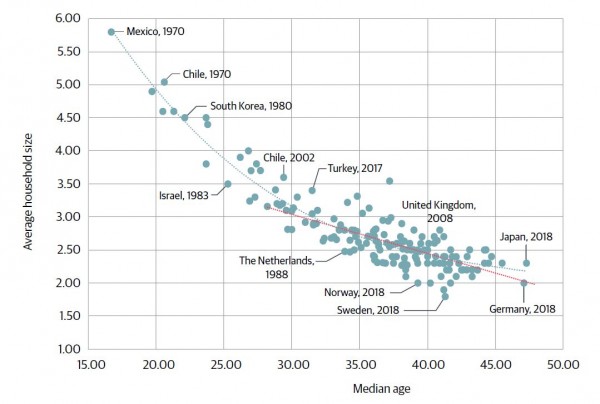
An older population results in fewer people living per dwelling and a larger population further increases housing needs. Across all the OECD countries, including New Zealand, the average household size has declined, which means more houses are needed per capita regardless of net migration levels.

In the report, we consider a range of housing for the period 2038 to 2060.

Under all the six most realistic scenarios, from 2019, we will need between 26,246 and 34,556 per year by 2038, and we will need between 15,319 and 29,052 additional dwellings per year by 2060.

The point is that cutting migration entirely would stop new housing demand – it does not because we still have an ageing population.

Even in extreme scenarios where net migration is zero for the next few decades, it does not stop new housing demand. By 2038, New Zealand would still need between 20,933 and 24,665 per year under medium life expectancy.

The report’s figures exclude the annual housing replacement rate, and the ongoing undersupply of 40,000 – estimated by Infometrics – adds to the chronic housing shortage.

What does all this mean for the outlook for housing in New Zealand?

The projected figures in the reports are well above the average annual construction rate of 21,445 since 1992. The implication is that house prices will rise a lot more unless house construction is much greater.

Fortunately, New Zealand is relatively young, with a median age of 37 years. Older countries across the OECD provide a window to the future. Kiwi policymakers have a unique opportunity to prepare what we can do now regarding housing policy.

In countries like Germany, the country is ageing, and the average household size has already been decreasing. Germany’s median age went from 37.6 in 1990 to 45.9 in 2020 and the average household size dropped from 2.3 to 2.0.

Since 1990, Germany’s population has been roughly stable at just above 80 million, but the household numbers went from 35 million in 1990 to 42 million in 2020 – 7 million more households in 30 years.

New Zealand is on a similar trajectory. New Zealand’s median age is currently close to 37 and is expected to increase to around 43 by 2038 and 50 by 2060. Our household size is also likely to drop from 2.6 to 2.4 by 2038 and even lower afterwards. The German illustration shows a potential image of New Zealand’s future, albeit with a far smaller total population size.

Even if annual construction increased closer to the 1970s, it would likely struggle to meet a more extensive and older population’s housing demand.

And estimating housing demand just on population growth is insufficient. On our projections, the dwelling stock in 2060 will be between 64% (‘low’ migration and ‘low’ fertility) and 26% (‘high’ migration and ‘high’ fertility), below what is needed to cater for the projected population need.

Tinkering the edges of demand will do little to address the chronic shortage in housing supply. Once the border opens, housing demand will continue to escalate, and the problem could become even worse.

All of this is fuel to the house fire, especially considering the revival of an open international economy after the global pandemic ends.

The housing crisis affects all Kiwis, but especially the millennials and Generation Z. There has been a growing intergenerational inequality preventing younger Kiwis from fulfilling their Kiwi Dream. The younger generation’s homeownership prospects are close to nil unless their parents are homeowners. Housing supply must expand substantially to give the younger generations a chance. 

Kiwi undiplomacy

“In archaeology, you uncover the unknown. In diplomacy you cover the known,” former United States Ambassador Thomas Pickering famously quipped. And Pickering’s wisdom is still relevant today.

In the aftermath of New Zealand’s free trade agreement upgrade with China, New Zealand Trade Minister Damien O’Connor decided to reprimand its Trans-Tasman neighbour. He believed that Australia should follow New Zealand and “show respect” and “a little more diplomacy” with the Chinese government.

This incident alarmed many senior members of the Australian government and created unnecessary tensions between the two nations.

Cosying up to the Chinese with an upgraded trade agreement is not something government ministers should brag about to the world.

His comment explicitly signals for the first time, that China could just assert pressure on countries such as New Zealand and even divide the Five Eyes security alliance.

Although both the Aussies and the Kiwis are part of the Five Eyes, each has its independent foreign policies. New Zealand took a more ambivalent approach towards China, while the Australians pursued an aggressive and defensive strategy.

Some of O’Connor’s  sentiments are understandable. Smaller powers such as New Zealand and Australia rely on the multilateral international order for its economic interests.

In an anarchic international system, great powers rule supreme.

China is a significant power across the Asia-Pacific. Under President Xi, the ‘Middle Kingdom’ has continued to exert itself across the world stage and expanded its influence across the region.

Therefore, it is vital to conduct foreign policy in a practical and realist manner.

For New Zealand, upgrading the free trade agreement was necessary for the country’s economic recovery, especially considering the global recession caused by the Covid-19 pandemic.

In the short run, the deal itself was the right step for New Zealand, especially considering the United States’ current circumstances. The new Biden Administration must deal with its domestic affairs before even thinking about returning to the Comprehensive and Progressive Trans-Pacific Partnership Free Trade Agreement, let alone containing the Chinese.

But O’Connor’s comments were not helpful. Australia is one of New Zealand’s critical western brothers and partners in the Five Eyes alliance. So isolating New Zealand from its security partners is not in its best interests.

In soft power, the less interest you reveal, the more superior you seem. As Pickering said, diplomacy is all about covering the known. Avoiding silly comments in the future would be the best way forward.

Leonard Hong is a Research Assistant at The New Zealand Initiative based in Wellington and a former intern at CIS.